
Anyone running e-commerce ads today can feel it: performance marketing doesn’t work the way it used to. What once could be fixed by changing a hook, rewriting a headline, or swapping a thumbnail now often stalls far too quickly. Following major algorithmic changes such as Meta’s Andromeda update, advertising platforms increasingly reward originality, depth, and visual relevance, not surface-level variations.
This shift is exactly why EcoWise Agency has fully specialized in AI creative marketing, helping e-commerce brands move away from isolated ad tests toward scalable creative systems.
When the Old Creative Playbook Stops Working
For years, creative testing followed a simple pattern. The product stayed the same, hooks changed, variations were tested, and winners were scaled. While effective in the past, today’s algorithms evaluate ads far more holistically. It is no longer just about the first few seconds. Visual context, pacing, storytelling, and brand signals all influence how a creative is distributed and scaled.
When ads stop feeling genuinely new, performance plateaus. Brands quickly realize they do not just need more ads, but more meaningful creative diversity.
This is where creative production becomes the real bottleneck. Producing dozens of truly different ad concepts traditionally requires photoshoots, locations, models, editors, and time. Costs rise, speed drops, and testing slows down. Many e-commerce teams know what they should test creatively, but simply cannot produce it fast enough.
EcoWise Agency sees AI not as a shortcut, but as a way to remove this bottleneck entirely.
Using AI to Multiply Creative Possibilities
A common misconception about AI creatives is that everything must be generated from scratch. In reality, many high-performing assets start from real photography or video. Existing product images or UGC-style shots can serve as the foundation, while AI adapts the surrounding context.
A product photographed in a neutral studio, for example, can appear in different environments, moods, or scenarios without reshooting. The product itself remains real and authentic, while the surrounding world is adjusted to fit different narratives, seasons, or audiences.
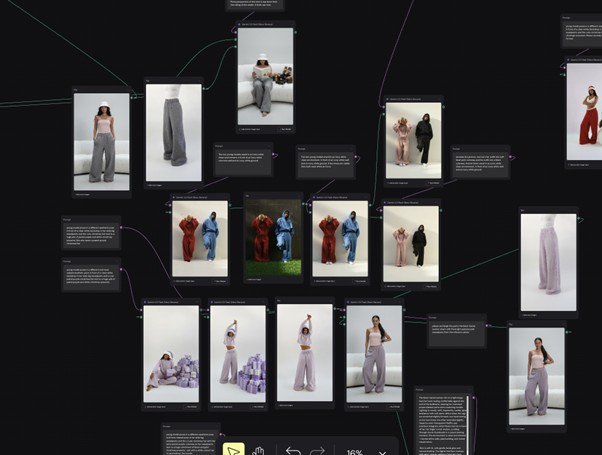
This flexibility also makes localization significantly easier. Instead of producing entirely new ads for each market, a single creative concept can be adapted modularly. Language, tone, cultural context, and even visual cues can be adjusted without rebuilding the entire asset. This allows brands to scale internationally while still feeling native to each audience.
What enables this level of scale is a shift away from linear production toward modular creative systems. Creative assets are built from flexible components such as visuals, poses, environments, and styling, which can branch into multiple variations. As illustrated in the workflow shown above, a single product and model can generate dozens of creative directions in parallel, including different outfits, colors, poses, and scenes. This allows rapid experimentation while maintaining consistency and brand control.
AI also changes how messaging is tested. Hooks, voiceovers, pacing, tone, and even language can now be adapted independently from the visual layer of an ad. Instead of restarting production for every new angle, messaging becomes modular. Brands can explore different emotional framings or communication styles without touching the core visual asset, which is especially valuable when scaling campaigns across audiences.
Turning Creative Production Into a System
Despite the technical complexity behind the scenes, working with EcoWise Agency is intentionally simple. Every collaboration starts with a strategic call to understand the business, previous advertising efforts, and creative direction. If there is a clear fit, a start date is set.
Brands then share their core inputs, such as product visuals, brand vibe, creative references, and any existing test results. Prior testing is helpful but not required. If none exists, the creative foundation is built from scratch. Within 48 hours, clients receive their first AI-powered creatives. From that point on, creative production continues on demand, with new ads continuously refined based on performance insights.
Creative output is closely connected to performance data through automated workflows. Learnings from live campaigns feed directly into the next wave of creatives, allowing winning directions to be expanded quickly while weaker ideas are replaced. Creative testing becomes a continuous system rather than a stop-and-go process.
EcoWise Agency actively challenges the assumption that AI-generated marketing must feel cheap or generic. According to the team, quality depends on structure, direction, and intent, not on whether AI is involved.
“AI doesn’t replace creative thinking,” the agency explains. “It rewards it.”
As AI tools continue to evolve, EcoWise Agency believes the brands that win will be those that use AI deliberately, to build distinctive, scalable creative systems instead of relying on outdated testing methods.
More insights and examples of EcoWise Agency’s AI creative work can be found here
instagram: ecowise.ai