
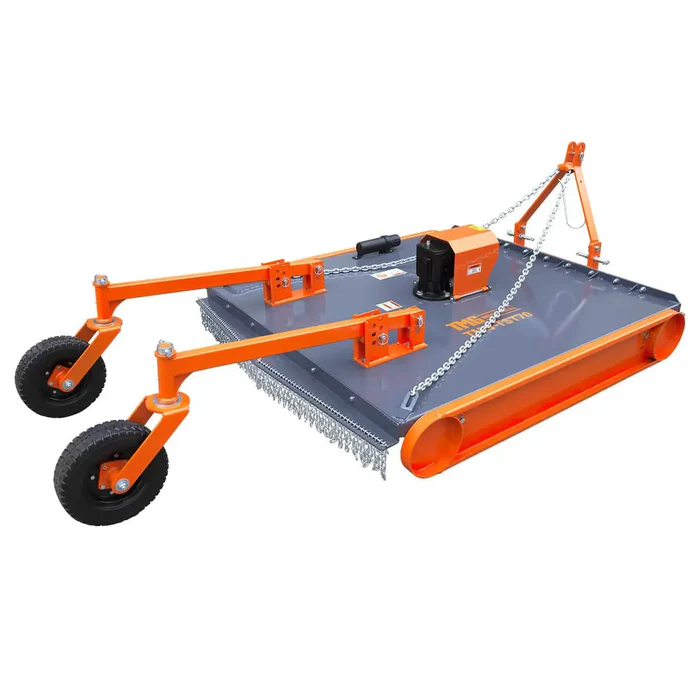
Effective vegetation management is a fundamental operational requirement across numerous industrial sectors, including utilities, logistics, civil construction, and large-scale property management. Uncontrolled growth of grass, weeds, and light scrub can obscure safety hazards, impede access for vehicles and personnel, damage infrastructure, increase fire risk, and present an unprofessional appearance. While pedestrian mowers and dedicated forestry equipment have their place, for operations that already utilize agricultural or utility tractors, a purpose-built tow-behind mower offers an efficient and versatile solution. A 70″ 3-Point Hitch Slasher Topper Mower represents a specific category of heavy-duty rotary cutter designed for this demanding environment. By leveraging the power and mobility of a tractor, it provides a robust, wide-swath method for maintaining large, often rough, areas of land. For land managers, facility supervisors, and procurement officers in the UK, the arrival of this established industrial equipment category—proven in markets such as the United States, Canada, Australia, and New Zealand—offers a new tool for cost-effective and systematic vegetation control.
Technical Operation and Industrial Application Spectrum
A 3-point hitch slasher topper mower is a rear-mounted tractor implement. It connects via the standard three-point linkage and derives its power from the tractor’s power take-off (PTO) shaft. The core mechanism is a sturdy gearbox that transfers power from the PTO to a horizontally rotating blade carrier, typically holding two or three free-swinging, high-carbon steel blades. These blades are designed to cut through tough vegetation not by slicing, but by imparting tremendous kinetic energy upon impact, effectively “slashing” the material. The “topper” designation often implies a lighter, faster-cutting action suitable for grass and weeds, distinguishing it from heavier “brush cutters” built for saplings. The 70-inch (approximately 1.78-meter) cutting width provides significant coverage per pass. Industrial and municipal applications are diverse and critical:
- Utility and Infrastructure Corridors: Maintaining clear zones under and around power lines, pipelines, and communication corridors to ensure access and safety.
- Transport and Logistics: Managing vegetation along perimeter fences, access roads, drainage ditches, and unused land within ports, rail yards, and large warehouse complexes.
- Civil Construction and Land Development: Clearing and maintaining vegetation on construction sites, future development land, and roadside verges.
- Agricultural and Estate Management: Topping pasture, managing paddocks, controlling weeds in orchards or vineyards, and maintaining firebreaks on large rural properties.
- Renewable Energy Sites: Maintaining grass and vegetation around solar farms and wind turbine bases to prevent fire hazards and ensure access.
The Strategic Importance for Operational Safety, Compliance, and Cost Control
Implementing a systematic mowing program with appropriate equipment is not merely a cosmetic exercise; it is a strategic operational function. From a safety perspective, regular mowing eliminates tall grass that can hide trip hazards, rodents, or discarded debris. It improves visibility for vehicle operators, particularly at intersections and along access roads, directly reducing collision risks. Clear vegetation around fences and buildings also deters trespassing and improves security sightlines. For compliance, many industries, especially utilities and hazardous material storage sites, are legally mandated to maintain specific clear zones for fire prevention and emergency access. Failure to comply can result in significant fines and liability. From a cost-control and productivity standpoint, proactive vegetation management prevents small problems from becoming large ones. Overgrown areas require more powerful, expensive equipment to reclaim. Regular mowing with a tractor-mounted unit is far more fuel and labor-efficient than sporadic clearing with underpowered or manual methods. It also protects capital investment in land and infrastructure by preventing damage from invasive roots or corrosive plant matter.
Technical Fundamentals and Tractor Compatibility
The effective and safe operation of a slasher mower begins with ensuring correct compatibility between the implement and the tractor. This is a fundamental engineering consideration. The implement is designed for tractors with a specific category of three-point hitch—typically Category 1 or 2 for a mower of this size. The hitch must have adequate lift capacity to raise the mower for transport and maneuvering. The most critical factor is hydraulic power: the tractor’s PTO must deliver the correct rotational speed (usually 540 revolutions per minute) and have sufficient engine horsepower to maintain that speed under the load of cutting dense material. A 70-inch mower generally requires a tractor in the 30 to 50 horsepower range, but manufacturer specifications must always be consulted. Key specifications of the mower itself include:
- Cutting Width: Directly determines work rate and coverage.
- Blade Design and Kinematics: The shape, weight, and mounting of the free-swinging blades dictate cutting efficiency, mulching capability, and durability when striking occasional solid objects.
- Gearbox Rating: The heart of the mower, it must be robustly constructed and correctly rated for the input power and shock loads it will encounter.
- Deck Construction: The mower deck should be made of thick, abrasion-resistant steel to withstand impact from thrown debris and the corrosive effects of plant sap and moisture.
- Skid Shoes and Height Adjustment: Adjustable skids allow the operator to set the cutting height and protect the deck from direct ground contact.
- Safety Features: These include a sturdy rear safety chain or shield to contain thrown objects and a slip clutch or shear bolt system on the PTO driveline to protect the gearbox from catastrophic failure if the blades jam.
Comprehensive Factors Influencing Performance and Service Life
The field performance, quality of cut, and longevity of a slasher mower are governed by a complex interplay of mechanical setup, operator practice, and environmental conditions.
- Tractor Power and PTO Performance: An underpowered tractor will struggle, causing the engine to lug down, which is inefficient and can damage both the tractor and mower driveline. Maintaining the correct 540 RPM PTO speed is essential for proper blade tip speed and cutting action.
- Vegetation Type and Condition: The density, moisture content, and stem thickness of the material being cut are the primary determinants of ground speed and power requirement. Damp, lush grass is easier to cut than dry, stalky weeds.
- Cutting Height and Frequency: Regular mowing at a higher cut is less stressful on the equipment than infrequent mowing of very tall, dense growth. A progressive approach—making a first pass at a high setting, then a second lower pass—is often best for overgrown areas.
- Ground Topography and Obstacles: Operating on uneven or sloped ground requires careful speed management and awareness of stability. The operator must be vigilant for hidden rocks, stumps, wire, or debris that could damage blades or the gearbox.
- Operator Skill and Technique: This includes selecting the appropriate gear for ground speed, overlapping passes correctly for complete coverage, and raising the mower to clear known obstacles.
- Driveline Maintenance: The PTO shaft must be the correct length, well-lubricated, and equipped with functioning safety shields. The slip clutch must be adjusted and maintained according to the manual; a rusted-solid slip clutch is a common point of failure.
- Blade Maintenance: Blades must be kept sharp (or replaced when worn) and securely fastened. Dull blades tear rather than cut, consuming more power and leaving a poor finish.
- Seasonal and Climatic Considerations: Mowing in very dry, dusty conditions increases wear and fire risk. Mowing when the ground is too soft can lead to rutting and scalping.
Safety Protocols and Operational Best Practices
Operating a tractor with a powerful, rotating cutter demands the highest level of safety consciousness. The consequences of negligence can be severe.
- Pre-Operation Inspection: A thorough walk-around must be conducted before each use. Check tractor tire pressure and fluid levels. Inspect the mower for loose or damaged parts, ensure all guards and shields are in place and secure, verify that the PTO shaft shield rotates freely, and check that blades are tight and not excessively worn or bent.
- Personal Protective Equipment (PPE): The operator must wear close-fitting clothing, sturdy safety boots, and hearing protection at a minimum. Safety glasses or a visor are highly recommended to protect against flying debris.
- Safe Start-Up and Engagement: Start the tractor with the PTO disengaged. Engage the PTO at low engine revolutions per minute and only when seated in the operator’s seat. Gradually increase engine speed to the operating range.
- Bystander Safety: Establish and maintain a clear safety zone of at least 100 feet (30 meters) around the operating mower. Absolutely no bystanders, especially children or pets, should be allowed in the area. The mower can throw objects like stones or metal fragments with lethal force.
- Operational Awareness: Be constantly aware of the mower’s position relative to ditches, slopes, fences, and overhead obstacles. Never engage the mower while it is raised high in the air. Always lower it to the working height before engaging the PTO.
- Slope Operation: Exercise extreme caution on slopes. Mow up and down slopes, not across them, to minimize the risk of tractor rollover. Know the stability limits of your specific tractor and mower combination.
- Clearing Blockages and Maintenance: Always disengage the PTO, shut down the tractor, remove the key, and wait for all moving parts to come to a complete stop before dismounting to inspect or clear the mower. Never use hands or feet to clear material from the deck or blades.
- Transport Safety: Fully raise the mower and secure the three-point hitch in the raised position for road transport. Ensure the mower is clear of the ground and that any transport locks are engaged. Reduce speed and be mindful of the increased width.
Equipment Types, Variants, and Complementary Systems
Within the category of 3-point hitch rotary cutters, there is a spectrum from light-duty finish mowers to heavy-duty forestry slashers. The 70″ slasher topper mower occupies a versatile middle ground, suitable for grass, weeds, and light brush. Key design variations include the number of blades (2 vs. 3), deck shape (flat vs. curved), and the type of blade attachment (bolt-on vs. stump jumper style). A critical feature is the driveline protection system: a shear bolt is simple and cheap but requires carrying spares and downtime for replacement; a slip clutch is more convenient but requires periodic adjustment to prevent it from seizing. For enhanced functionality, some mowers offer offset capabilities to reach under fences or offset wing kits to achieve even greater cutting widths. The integration of the mower into a broader land management system might also involve a tractor with a climate-controlled cab for operator comfort and a GPS system for documenting mowing coverage for compliance purposes.
Advantages and Practical Limitations
The primary advantages of a tractor-mounted slasher mower are its high productivity over large areas, its ability to handle rough and uneven terrain that would defeat a conventional lawn mower, its durability and relatively simple mechanical design, and its efficient use of an existing tractor asset for multiple purposes. It is a cost-effective solution for the scale of vegetation management required by industrial sites.
The limitations are equally important to recognize. It is not a precision landscaping tool; the cut finish is functional rather than manicured. Its effectiveness is wholly dependent on having a correctly sized and available tractor. Operating in very rocky or debris-laden areas significantly increases the risk of blade and gearbox damage. The machine is loud and produces significant vibration. Furthermore, the initial capital outlay, while lower than a dedicated self-propelled mower of similar capacity, is still substantial, and it requires a skilled and safety-conscious operator to be effective. For very small or highly manicured areas, it is not the appropriate tool.
Real-World Implementation Scenarios
Consider a regional electricity distribution company responsible for maintaining thousands of miles of rural overhead power lines. Vegetation encroachment is a constant threat to reliability and safety. Each maintenance crew is equipped with a utility tractor and a 70-inch slasher mower. They systematically patrol the rights-of-way, mowing a wide swath beneath the lines. This regular management prevents trees from growing into the lines, ensures safe access for repair vehicles, and reduces the need for more expensive and environmentally disruptive chemical sprays or forestry mulchers. The tractor’s versatility also allows it to be used for other tasks like pole setting or material transport.
In another example, a large logistics park with extensive perimeter fencing and internal drainage ditches uses a similar setup. The facility’s grounds team uses the tractor and mower to manage all non-landscaped grassy areas. This keeps the site looking professional, reduces fire fuel load, prevents drainage channels from becoming blocked, and deters pests by eliminating tall grass habitats. The ability to quickly respond to growth spurts after rain ensures the site always meets the company’s safety and presentation standards.
Conclusion and Future Trends in Industrial Vegetation Management
The 3-point hitch slasher topper mower is a proven, robust, and highly effective tool for the systematic management of vegetation on an industrial scale. Its value proposition is strongest for organizations that already operate tractors and have recurring, large-area mowing requirements. For the UK market, the introduction of this equipment category provides land managers and industrial operators with another proven option for meeting their duty of care regarding site safety, compliance, and asset protection.
Successful implementation is not merely about purchasing the equipment. It requires a holistic approach encompassing proper tractor-implement matching, comprehensive operator training with an unwavering emphasis on safety, a disciplined preventive maintenance schedule, and strategic planning of mowing cycles to balance cost and effectiveness. As environmental and safety regulations continue to tighten, and as the economic pressure to optimize asset utilization grows, the role of efficient, tractor-based vegetation management systems is likely to remain central. Future trends may see greater integration of technology, such as automated guidance systems for optimal coverage, sensors to monitor blade wear or driveline load, and even autonomous tractor-mower combinations for hazardous or repetitive mowing tasks. However, the core principles of matching powerful, durable equipment to the task, and prioritizing operator training and safety, will continue to define best practice in industrial land management for the foreseeable future