
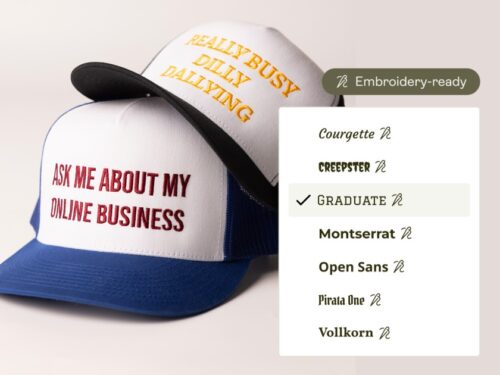
Custom embroidery has traditionally been a bottleneck for print-on-demand entrepreneurs. Unlike digital printing, embroidery requires a complex “digitization” process where artwork is converted into stitch patterns, often leading to long wait times and technical errors. For small businesses trying to scale, these delays make it difficult to offer personalized products quickly and profitably.
Carolina Vitantonio, Product Marketing Manager at Printify, is at the forefront of solving these production hurdles. Printify recently launched a suite of embroidery-ready fonts designed to bypass the digitization phase entirely, allowing for instant, high-quality embroidery customization. In this interview, Vitantonio explains how this new technology simplifies the design process and what it means for the future of the print-on-demand industry.
Q: Printify recently introduced embroidery-ready fonts to the platform. What was the primary problem you were trying to solve for merchants with this update?
Carolina Vitantonio: The main problem we set out to solve was the complexity and delay caused by digitization in embroidery. Traditionally, every embroidery design has to go through a digitization process where artwork is converted into stitch files for the first time before production can begin. That step can take up to 36 hours and often feels intimidating, especially for newer merchants. It also introduces uncertainty as designs can fail digitization or require adjustments, slowing everything down.
With embroidery-ready fonts, we’ve eliminated that friction for text-based designs. These fonts are already fully digitized and optimized for embroidery, so merchants can create and sell personalized embroidered products without worrying about delays or technical hurdles. Our goal was to make embroidery as simple and scalable as other print methods on the platform.
Q: Can you explain the technical difference between using these new fonts and the traditional process of digitizing an embroidery design?
Carolina Vitantonio: Traditionally, when a merchant uploads a design for embroidery, that file has to be converted into a stitch pattern. This digitization process maps out how the machine will stitch the design, everything from stitch direction to density. It’s highly technical and must be done before production begins.
With our embroidery-ready fonts, that step has already been completed. The stitch patterns are pre-mapped and optimized for embroidery production. So when a merchant uses one of these fonts for text – such as a name, initials, or a short phrase – the design goes straight into production without any additional digitization required.
If a design includes a graphic element, digitization is only required once to account for that graphic. After that, personalized text using the embroidery-ready fonts can be updated per order without triggering digitization again. That’s a major shift in efficiency.
Q: Many merchants worry about the quality and durability of embroidered products. How do these pre-digitized fonts ensure a consistent, professional result?
Carolina Vitantonio: Quality and consistency were central to how we developed this feature. Each embroidery-ready font has already gone through the full digitization process, with stitch patterns carefully mapped and optimized specifically for embroidery production.
Because these stitch files are standardized and production-ready, merchants can feel confident that the results will be consistent across orders. There’s no variability caused by repeated or rushed digitization. The outcome is professional, durable embroidery that meets the expectations customers have for premium stitched products.
By removing the trial-and-error aspect of digitization, we’re helping merchants deliver high-quality results from day one.
Q: Speed is a major factor in e-commerce. How does this new feature impact the time it takes for a merchant to go from a design concept to a live product in their store?
Carolina Vitantonio: That´s right! Speed is critical in e-commerce, especially in personalization where customers expect quick turnaround. Traditionally, the digitization step alone could add up to 36 hours before an order even entered production. With embroidery-ready fonts, that waiting time is reduced to zero for text-based designs.
Merchants can create a product, publish it to their store, and start accepting orders immediately – without worrying about production delays tied to digitization. Orders move straight into production, which means faster fulfillment and a better customer experience.
For sellers operating at scale, especially in personalized products, eliminating repetitive digitization steps makes the entire workflow faster and far more predictable.
Q: Personalization is a massive trend in custom apparel. How do these fonts help small businesses compete with larger retailers in the personalized gift market?
Carolina Vitantonio: Personalization is one of the fastest-growing segments in custom apparel, but embroidery has often been seen as too complex or slow for small sellers to fully leverage. By pre-digitizing our fonts, we’ve removed one of the biggest barriers to entry.
Now, small businesses can offer custom embroidered names, initials, or short phrases without worrying about extra setup time or production delays for each order. Because digitization isn’t triggered every time the text changes, merchants can confidently offer high-volume personalization while maintaining fast turnaround times.
This levels the playing field. Independent creators can now provide premium, embroidered personalized products with the same speed and reliability that larger retailers offer, without additional cost or operational complexity.
Q: Looking ahead, how do you see Printify’s embroidery technology evolving to further support the growth of independent creators?
Embroidery-ready fonts are just one step in our broader investment in making advanced customization more accessible. We’re continuously improving our personalization tools and automation features to better align with how print-on-demand merchants actually work.
Looking ahead, we’re focused on expanding capabilities that make embroidery richer, more intuitive, and easier to scale, while keeping the process simple. Our goal is to remove technical barriers so creators can experiment, diversify their product catalogs, and grow their businesses without added complexity.
We want embroidery to feel like a streamlined, scalable option – not a specialized or intimidating add-on. By continuing to innovate in personalization and automation, we’re helping independent creators stay competitive in a market where speed, quality, and customization are key.
This interview highlights a significant shift in how custom apparel is created. By removing the technical barriers of digitization, Printify is enabling merchants to focus on creativity and customer service rather than production logistics. The introduction of embroidery-ready fonts not only saves time but also ensures that high-quality, professional stitching is accessible to businesses of all sizes.
As the demand for bespoke, personalized goods continues to rise, tools that prioritize speed and simplicity will become essential. Carolina Vitantonio and the team at Printify are setting a new standard for the industry, ensuring that embroidery is no longer a complex outlier but a streamlined, scalable option for global entrepreneurs.
To learn more, visit https://printify.com/