
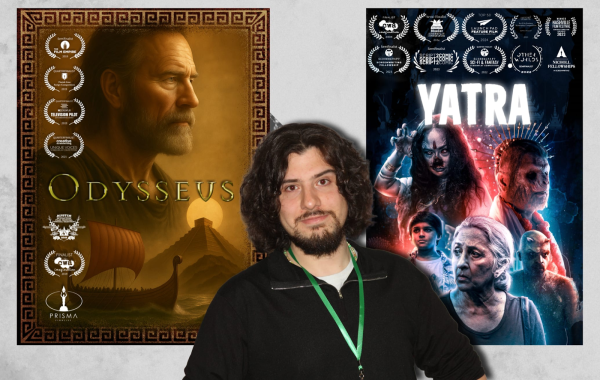
Los Angeles–based Italian screenwriter David Barbeschi has built his career on structure, theme, and character-driven storytelling. Working across commissioned features, festival-recognized scripts, and genre projects, his approach blends disciplined craft with emotional clarity. In this conversation, Barbeschi reflects on what inspires him, how he develops ideas, and the process behind turning concepts into fully realized screenplays.
If you could adapt any book, event, or story into a screenplay, what would it be and why?
I’d adapt the Telegony, and I actually did.
It’s the lesser-known sequel to The Odyssey, centered on Telegonus, the son Odysseus never knew he had with Circe. In the original myth, he unknowingly kills his own father. I… don’t think that’s a decent ending for Odysseus.
In my project, I expand the Telegony into a long-form series that crosses over with Mayan mythology and explores what happens after The Odyssey. Odysseus is older, fractured, yet still sailing to South America to rescue a son who may not want to be saved. His other son Telemachus is back home trying to prove he can be a better man than his father. It becomes a story about legacy, responsibility, and what we pass down without meaning to.
What’s the last film or TV show you watched that really inspired you?
I would say: His/Hers on Netflix and Predator: Badlands.
With His/Hers, the ending twist was beautifully set up and yet completely surprising. As a screenwriter, I am trained to recognize structure, so I could see the smaller episode-end turns coming. But that final reveal genuinely caught me off guard, which is rare. It reminded me how powerful disciplined setup and payoff can be when executed with patience and restraint.
I went into Predator: Badlands expecting something predictable. Instead, what looks structurally simple on the surface is actually a very clean modern retelling of classic mythic motifs, executed with precision. Emotionally, every beat lands. Structurally, every setup is paid off efficiently. The result feels like a rewatchable classic, in the same way the original Star Wars does.
How do you start the process of writing a script?
In my case, a high percentage of the screenplays I’ve written were done so on commission. Based on what my clients want to get out of this screenplay, I’ll choose one key storytelling ingredient as a starting point, then build around it.
Some projects, like “Bring Her Back,” directed by Constance Ebienfa or “Belle de Nuit” a multi-award-winning project starring and produced by Maurice Kadamani of Every Picture Films were more personal in nature, and so the key element there was developing the theme of those stories to their satisfaction, (respectively, the themes of grief and depression) and then making those themes the main character.
On other projects, such as “Yatra,” my executive producer Vee Kumari – who came up with the original concept – realized that there’s a big gap between a good idea, and a fantasy script that had to keep readers enthralled. So there, coming up with a strong structure was the priority, first and foremost.
Later, once the third draft earned placements in several script competitions, Vee Kumari and I went back to zero-in on theme, which resulted in the current script that was a selection for the 2024 Academy’s Nicholl Fellowship and a finalist in 2025’s Tasveer Film Fund, among other prestigious screenplay contests.
Finally, I’ve recently been hired to write more self-contained films, in the horror and noir genres. Here, its character development was the name of the game. If the locations aren’t varied, if the action is limited, then it is essential that the characters be intriguing.
For Barbeschi, every script begins with a clear foundation, whether that’s theme, structure, or character. From there, everything else follows.
To learn more about his work, visit www.davidthescreenwriter.com.