
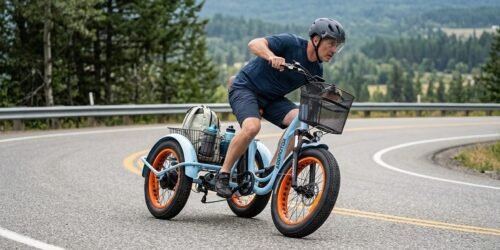
Addmotor, a manufacturer specializing in electric bike solutions, has released the technical overview of its newest model, the U-Trike U-750. This three-wheel electric bike marks a clear evolution from conventional rigid frame tricycles, introducing a refined central‑pivot mechanism that enables controlled leaning during cornering. By separating the front steering assembly from the rear drive module, the U-750 is engineered to overcome the inherent kinematic constraints of standard three-wheel designs—particularly the challenge of managing centrifugal forces during higher-speed directional transitions.
Kinematic Analysis: The Pivot Steering Mechanism
The primary engineering distinction of the U-750 is its central pivot joint. In a standard rigid electric tricycle, the vehicle remains on a fixed vertical plane, which forces the rider to counteract an outward centrifugal pull during turns. At higher velocities, this force can compromise traction or lead to wheel-lift on the inner radius of the turn.
The U-750’s tilting mechanism trike architecture allows the rider to tilt the front frame and steering column while the rear wheel module—which houses the motor and battery—remains level and grounded. This “pivot = freedom + stability” design allows the center of mass to shift inward during a turn, effectively neutralizing the centrifugal force. This mechanical adaptation allows the vehicle to maintain a consistent contact patch across all three tires while navigating corners with an agility profile more akin to a two-wheeled bicycle than a static tricycle.
Electronic Architecture and Power Modulation
The propulsion system of the U-Trike U-750 is centered around a 48V 750W rear-mounted motor. To ensure precise power delivery, especially during the dynamic shifts inherent in a leaning vehicle, Addmotor has integrated a high-precision torque sensor. Unlike traditional cadence sensors that provide binary assistance based on pedal rotation speed, the torque-sensing system measures the actual mechanical force applied to the pedals in real-time. This allows for proportional motor assistance, ensuring that power delivery remains smooth and predictable even when the vehicle is at a high lean angle.
Energy is supplied by a 48V 20Ah Samsung 21700 cell battery pack. The UL-2271 certification ensures compliance with rigorous thermal and electrical safety standards for the lithium-ion cells. Under testing parameters, the battery provides a range of 40 to 85 miles per charge, depending on pedal-assist levels and environmental conditions. The system is managed by a 25A controller within the EB 2.0 electronic ecosystem, providing seven levels of pedal assistance and a variable-speed 1/2-twist throttle.
Structural Engineering and Mechanical Specifications
The U-750 is constructed from 6061 aluminum alloy, a material chosen for its strength-to-weight ratio and resistance to the torsional stresses generated by the pivot mechanism. The vehicle’s net weight is approximately 110 lbs (50 kg), with a total payload capacity of 450 lbs—350 lbs for the rider and 100 lbs for rear-mounted cargo.
The wheel configuration adopts a unified setup using identical 20″ × 4.0″ fat tires on both the front and rear. The wide 4.0‑inch profile provides a significantly larger contact patch than standard trikes, increasing friction and damping to create a more stable and forgiving lean during tilting operation. The uniform tire sizing also supports consistent handling characteristics and balanced weight distribution, helping the vehicle maintain smooth, predictable performance when navigating road irregularities or uneven terrain.
For shock absorption, the U-750 features the Addshox oil spring suspension fork with 80mm of travel. The braking system comprises three mechanical disc brakes, providing independent stopping power to each wheel. A manual parking brake is integrated into the handlebar assembly, allowing the rider to lock the frame in a vertical position when stationary or parked on an incline.
Dual-Mode Operational Logic
To accommodate varying rider proficiencies, the U-Trike U-750 features a manual locking mechanism that enables two distinct operational modes:
- Fixed Mode: The pivot joint is mechanically locked, preventing any lateral movement. In this configuration, the U‑750 behaves like a conventional rigid tricycle, delivering maximum stability for beginners, seniors, or situations involving heavy cargo.
- Tilting Mode: The pivot is unlocked, activating the full lean‑to‑turn capability. This mode is designed for active riding and higher‑speed cornering, allowing the vehicle to take advantage of its tilting mechanism for enhanced maneuverability and a more responsive handling profile.
Safety and Integration Systems
The vehicle is equipped with the EB 2.0 5-in-1 taillight module. This integrated system provides several critical functions:
- Brake Indication: Automatic illumination during deceleration.
- Directional Signals: Controlled via handlebar-mounted switches.
- Hazard Lights: For increased visibility in low-light or emergency conditions.
- Night/Running Lights: Integrated with the 40 LUX battery-powered headlight.
Riding parameters—including battery level, mileage, velocity, and PAS status—are monitored via a 5-inch LCD display located on the handlebars.
Conclusion
The Addmotor U-Trike U-750 represents a significant technical evolution in the electric tricycle sector. By shifting from a purely static frame to a multi-mode tilting architecture, the vehicle offers a solution to the traditional trade-off between stability and maneuverability. The integration of fat-tire physics with a central pivot joint addresses the needs of urban logistics and personal recreation within a single, adaptable platform.
For more technical data or engineering inquiries regarding the U-750 Tilting eTrike, please contact the Addmotor press department.
About Addmotor
Addmotor is an electric bike manufacturer dedicated to developing inclusive mobility solutions for a broad range of user demographics. The company’s engineering focus includes the development of high-performance electric bicycles and tricycles that integrate safety, utility, and advanced electronic control systems.
Safe Harbor Statement
This press release contains technical information regarding product specifications and intended use. Actual performance may vary based on load, terrain, and weather conditions. All specifications are subject to change without notice for the purpose of continuous product improvement.