
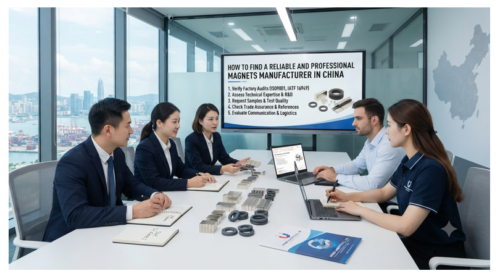
Magnets power everything from electric motors and wind turbines to medical devices, speakers, and everyday household gadgets. Because so much depends on their quality, sourcing them from the right supplier is one of the most important decisions a buyer can make. China remains the world’s largest hub for magnet production, offering unmatched manufacturing scale, technical expertise, and competitive pricing. But with thousands of suppliers competing for attention, how do you separate the professionals from the risky middlemen?
This guide walks through the practical steps for identifying a trustworthy magnets manufacturer in China, what to look for in terms of certifications and capabilities, and why working with an established name in China magnets production can save you time, money, and headaches down the road.
Why China Dominates the Global Magnet Industry
China controls the majority of the world’s rare earth element supply, which is the raw material behind neodymium, samarium cobalt, and other high-performance magnets. This natural advantage, combined with decades of investment in manufacturing infrastructure, means Chinese factories can offer:
- Lower production costs due to vertical integration (from raw material processing to finished product)
- A wide range of magnet types, including neodymium, ferrite, alnico, and SmCo magnets
- Custom manufacturing capabilities for unusual shapes, sizes, and coatings
- Large-scale production capacity for bulk orders
That said, scale alone doesn’t guarantee quality. The real challenge is identifying which factories combine that scale with consistent engineering standards and honest business practices.
Step 1: Verify Manufacturing Capabilities, Not Just Claims
Many trading companies in China present themselves as manufacturers when they are actually resellers who outsource production. This isn’t necessarily bad, but it does mean less control over quality and lead times. A genuine manufacturer will typically:
- Own its production facility and equipment (pressing, sintering, machining, coating lines)
- Be able to show photos or video of the factory floor
- Offer engineering support for custom magnet designs
- Provide in-house testing equipment such as gaussmeters and pull-force testers
If a supplier hesitates to share this information or avoids specific questions about their production process, that’s a warning sign. A well-established company such as aomag.com will typically be transparent about its facilities and willing to walk potential clients through its capabilities.
Step 2: Check Certifications and Quality Standards
Reliable manufacturers operate under recognized quality management systems. Look for certifications such as:
- ISO 9001 – general quality management standard
- ISO 14001 – environmental management
- IATF 16949 – required for automotive-grade magnet suppliers
- RoHS and REACH compliance – important for magnets used in electronics sold in the EU and other regulated markets
These certifications aren’t just paperwork. They indicate that a factory follows documented processes for material sourcing, production consistency, and defect control. Ask suppliers to provide certificate copies and, if possible, third-party test reports for the specific magnet grade you need.
Step 3: Evaluate Product Range and Specialization
A manufacturer that produces a narrow but well-optimized product line often delivers better consistency than one claiming to make “everything.” For example, a supplier specializing in radial ring magnets will likely have refined tooling, magnetization equipment, and quality checks specifically suited to that geometry — which matters a great deal for applications like motors, sensors, and encoders where radial magnetization uniformity directly affects performance.
When evaluating a manufacturer, ask:
- Do they have experience with your specific magnet shape and grade?
- Can they provide magnetic field mapping or B-H curve data?
- Do they offer prototyping before committing to full production runs?
- What tolerances can they consistently hold?
A supplier that can answer these questions with specific numbers and data — rather than vague reassurances — is generally more trustworthy.
Step 4: Request Samples Before Placing a Bulk Order
No matter how strong a supplier’s website or sales pitch looks, physical samples remain the best way to judge quality. When requesting samples:
- Ask for the exact grade and specification you intend to order in bulk
- Test the magnets for pull force, dimensional accuracy, and coating durability
- If the application involves temperature extremes, test performance under those conditions
- Compare samples from two or three different suppliers side by side
Reliable manufacturers are usually willing to provide samples, sometimes free for small quantities or at a nominal cost that’s credited back on a future order.
Step 5: Assess Communication and Responsiveness
Manufacturing quality matters, but so does the ability to communicate clearly across time zones and language barriers. During initial inquiries, pay attention to:
- Response time to technical questions
- Whether the sales team understands engineering terminology or just repeats generic answers
- Willingness to provide a dedicated contact person for your account
- Clarity around lead times, MOQs (minimum order quantities), and payment terms
A supplier that responds promptly and precisely to technical questions early on is far more likely to handle production issues professionally if they arise later.
Step 6: Review Their Online Presence and Track Record
A manufacturer’s website, product catalog, and client history offer useful clues about their professionalism. Look for:
- Detailed technical pages for specific magnet types rather than generic marketing copy
- Case studies or industries served (automotive, electronics, renewable energy, medical)
- Years in operation and export experience
- Reviews or references from past clients, where available
Companies that have built a long-standing presence in the industry, such as aomag.com, tend to have refined their processes over years of working with international clients, which reduces the learning curve and risk for new buyers.
Step 7: Understand Shipping, Packaging, and After-Sales Support
Magnets are fragile in certain forms and can also interfere with shipping equipment if not packaged correctly (strong magnets can affect compasses, credit cards, or even aircraft instruments if improperly shielded). A professional manufacturer will:
- Use demagnetized shipping or proper magnetic shielding during transport
- Package magnets to prevent chipping, especially for sintered NdFeB grades which are brittle
- Provide clear documentation for customs, including HS codes and safety data sheets
- Offer after-sales support for defective batches or specification mismatches
Ask potential suppliers directly how they handle magnetic shielding for international shipments — this is a good litmus test for how seriously they take logistics.
Common Red Flags to Watch For
While evaluating suppliers, be cautious of:
- Prices significantly lower than the market average with no clear explanation
- Reluctance to provide certifications or test data
- No clear factory address or inability to arrange a video call/factory visit
- Pressure to pay the full amount upfront before any sample verification
- Inconsistent or copy-pasted responses to technical questions
None of these factors alone is necessarily disqualifying, but multiple red flags together suggest it’s worth looking elsewhere.
Final Thoughts
Finding a reliable magnets manufacturer in China comes down to due diligence: verifying real production capability, checking certifications, testing samples, and paying attention to how a supplier communicates and handles logistics. The market is large enough that buyers have plenty of options, but that also means the responsibility falls on the buyer to vet suppliers carefully rather than choosing based on price alone.
For companies looking for a manufacturer with a proven track record — whether the need is standard radial ring magnets or a fully custom magnetic solution — working with an experienced magnets manufacturer that combines technical expertise with transparent business practices makes the sourcing process considerably smoother and reduces the risk of costly mistakes down the line.