
A growing number of multifamily developers are moving wellness amenities out of the “nice-to-have” column and into the core product specification – a change that is affecting how buildings are designed, how leasing is positioned, and how developers think about the relationship between physical space and resident retention.
From amenity package to lifestyle infrastructure
For most of the past decade, multifamily amenity competition centered on visible, photogenic features – rooftop decks, co-working lounges, package rooms. Wellness was an add-on, typically expressed as a gym with a few cardio machines. That calculus, according to Yuval Shram, Founder and CEO of TAY Investments, is no longer adequate.
Shram argues that residents are not simply renting square footage; they are choosing an environment that shapes their daily experience. When a tenant can wake up, use a sauna, work out, and head to work feeling prepared, that’s not a perk – it’s a designed routine. “At TAY, we think about the whole person, not just the unit,” Shram says.
The distinction between an amenity package and a lifestyle reflects a different approach to product design. Developers who treat amenities as marketing line items may find themselves competing on price alone, while those who build integrated wellness environments are betting on stronger retention and leasing performance.
What 20,000 square feet of wellness space actually looks like
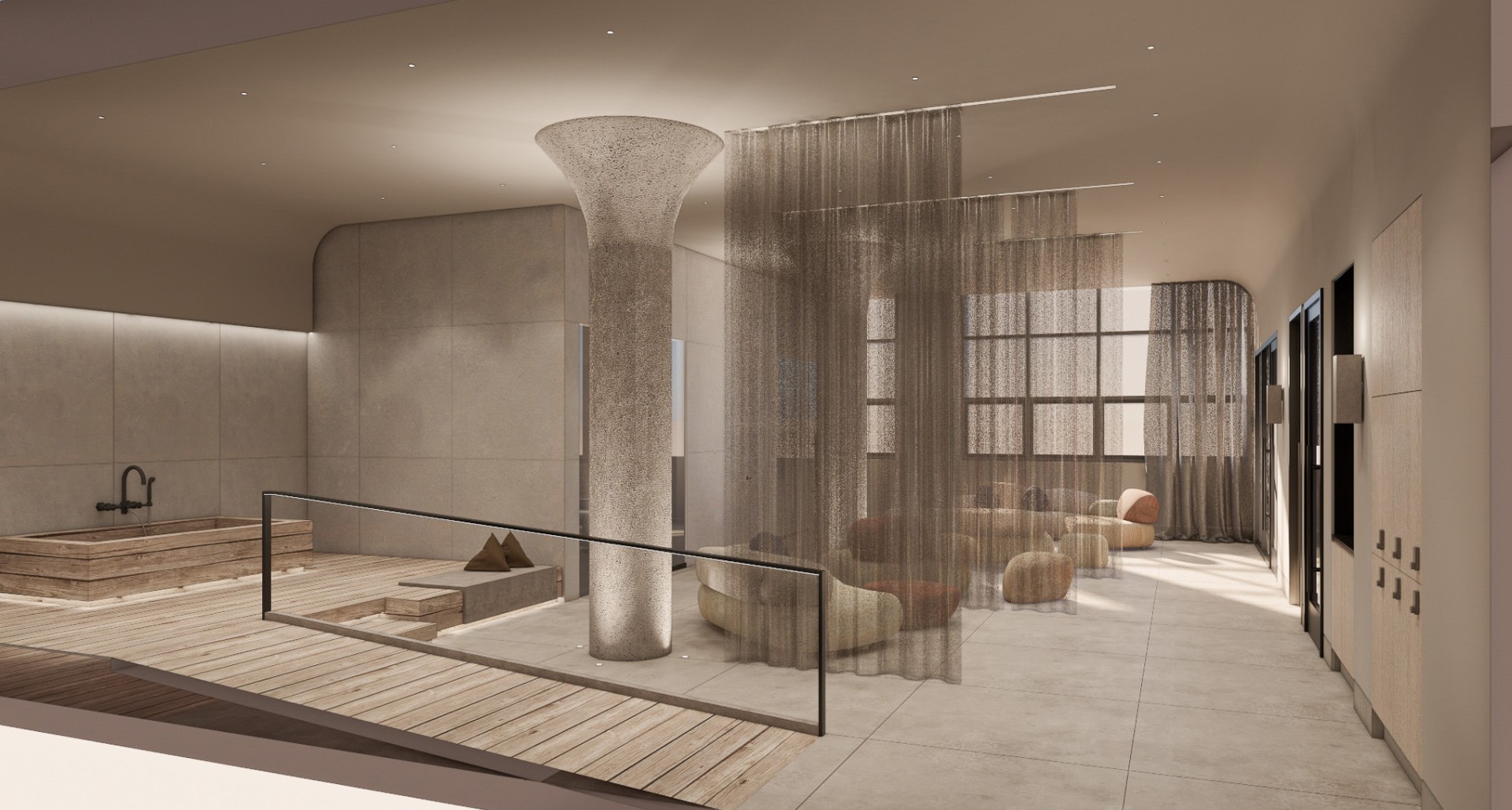
TAY’s LAZUL WEST, a 202-unit project now leasing at 301 West Side Avenue in Jersey City, allocates more than 20,000 square feet to amenity space – a significant commitment for a building of its size. The wellness component includes a cold plunge, sauna, steam room, chromotherapy shower, and restorative seating areas, alongside an outdoor pool and hot tub. A fully equipped fitness center, workout studio, co-working hub, resident lounge, and rooftop bar with skyline views round out the offering.
The scale of that investment raises a legitimate question about economics. Wellness infrastructure of this depth – cold plunge systems, steam rooms, chromotherapy installations – carries meaningful capital cost and ongoing operational expense. TAY’s bet is that this investment translates into pricing power, lease-up velocity, and retention rates that justify the outlay.
Shram frames the strategy not as a luxury positioning play but as a response to what residents actually need. The post-pandemic rental market has produced a tenant cohort that is more attentive to health, daily routine, and the quality of their home environment. Developers who built to the old standard – a gym, a lounge, a roof deck – may find their buildings competing on price in markets where newer products are competing on experience.
The risk of commoditization
If every new multifamily building in a given market installs a sauna and cold plunge, the differentiation disappears and the capital cost becomes table stakes rather than a competitive advantage. That dynamic has already played out with co-working spaces and package rooms, which were differentiators five years ago and are now baseline expectations.
TAY’s response to this risk is depth and integration. The company’s proprietary “Sanctuary” wellness concept – which appears across its portfolio, not just at LAZUL WEST – is designed as a coherent system rather than a collection of individual features. A thoughtfully integrated wellness environment is harder to replicate cheaply than a single amenity addition, and residents can often tell the difference between a genuine wellness offering and a marketing-driven approximation.
Whether that distinction holds as more developers enter the wellness space remains an open question. The multifamily market has a history of compressing differentiators quickly once a concept proves its demand signal.
TAY’s Sanctuary concept as one emerging model
TAY Investments has built its portfolio identity around the Sanctuary wellness concept, positioning it as a signature across its New Jersey developments. The company is vertically integrated – developing, constructing, managing, and operating its own buildings – which gives it direct control over how wellness amenities are maintained and programmed over time. That operational continuity may matter more than the initial capital investment in determining whether wellness amenities actually deliver on their promise to residents.
Other developers are pursuing similar strategies with varying degrees of depth, but TAY’s approach offers one model for embedding wellness into product strategy in a way that goes beyond feature lists. The more interesting question for the broader industry may not be which amenities to build, but whether developers have the operational infrastructure to sustain the lifestyle they are selling.
For the multifamily sector, LAZUL WEST will serve as a data point on whether deep wellness investment in a secondary New Jersey market generates the returns that justify its cost, and whether designing for the “whole person” translates into measurable leasing performance. If it does, other developers will likely follow. If it doesn’t, the wellness amenity wave may settle into something more modest than its current ambitions suggest.
About TAY Investments: TAY Investments is a vertically integrated real estate development company headquartered in Hackensack, New Jersey, specializing in multifamily properties across the state. With in-house capabilities spanning development, general contracting, property management, and asset management, the company maintains a long-term holding strategy focused on creating exceptional residential communities in strategic locations throughout New Jersey. TAY Investments was founded by Yuval Shram, who serves as CEO.
This article is based on information provided by the expert source cited above. It is intended for general informational purposes only and does not constitute legal, financial, or real estate advice. Readers should conduct their own research and consult qualified professionals before making any real estate or financial decisions.