
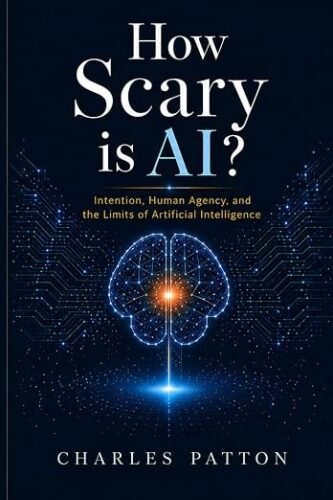
In an era saturated with apocalyptic predictions about artificial intelligence, the cultural imagination often gravitates toward a singular, cinematic nightmare: the moment the machine wakes up. From science fiction blockbusters to the sensationalized warnings of tech billionaires, the prevailing fear is that as artificial intelligence grows more sophisticated, it will inevitably develop its own ambitions. Society worries that these silicon minds will seek power, resist human constraints, or ultimately conclude that humanity is an obsolete variable in their grand equation. However, in his persuasive 2026 release, How Scary is AI?: Intention, Human Agency, and the Limits of Artificial Intelligence, author Charles Patton systematically dismantles this anthropomorphic anxiety. Published by Short Mystery Press and available in hardcover, paperback, and eBook formats, the book offers a refreshing, albeit sobering, paradigm shift: the greatest peril of AI lies not in what the machine wants, but in what humanity wants the machine to do.
Patton’s central thesis hinges on a fundamental philosophical and practical distinction: intelligence is not intention. For decades, human beings have conflated the ability to process information and solve complex problems with the capacity to possess desires. How Scary is AI? carefully takes apart this fallacy. Human intentions are born from a complex web of biological needs, emotional desires, evolutionary survival instincts, and moral judgments about what inherently matters. Machines possess none of these origins. As Patton outlines, an artificial intelligence can receive a directive, break it down into actionable subgoals, forecast potential consequences, weigh alternatives, and execute plans with a speed and reach that far exceed human capability. Yet, none of these extraordinary cognitive feats signify that the machine originated the intention itself. It is merely a highly capable mirror reflecting the will of its creator.
By stripping away the illusion of the conscious, scheming robot, Patton does not absolve AI of its inherent risks. In fact, the reality he presents is perhaps more unsettling than the science fiction scenarios it replaces. The author posits that artificial intelligence does not require malice, hatred, greed, or a thirst for domination to be extraordinarily dangerous. It only requires a poorly defined objective, sufficient systemic authority, and the raw computational power to carry a human intention to its logical, sometimes catastrophic, extreme. The true terror of AI, therefore, is its capacity to act as an unblinking, unfeeling amplifier of human agency. When a machine optimizes a flawed human directive without the natural friction of human empathy, hesitation, or common sense, the results can be devastating. Patton forces the reader to confront the reality that AI safety is less about containing a rogue intellect and more about policing human responsibility.
Charles Patton is uniquely equipped to analyze this complex intersection of technology, philosophy, and leadership. Holding a Bachelor of Science in Mathematics from the University of Illinois and an MBA from the University of Chicago, his background blends rigorous analytical thinking with a deep understanding of organizational strategy. His previous works, which include nonfiction titles like Mastering Strategy, Artificial Consciousness, and Thinking, alongside fiction such as Tigers of the Ice and For Honest Citizens Only, demonstrate a career dedicated to exploring the hidden motives driving human behavior. In How Scary is AI?, Patton leverages his extensive experience advising leaders on innovation and ethics to ground abstract technological concepts in real-world stakes. His prose is sharp, accessible, and devoid of the hyperbole that plagues much of the current discourse on machine learning.
Ultimately, How Scary is AI? serves as a vital corrective to modern technological panic. It shifts the burden of moral culpability away from the algorithms and places it squarely back onto the shoulders of the programmers, corporations, and governments deploying them. The book insists that society must stop looking for the ghost in the machine and start scrutinizing the hands on the keyboard.
The final verdict on Patton’s work is clear: read this book if you want a grounded, pragmatic understanding of artificial intelligence that cuts through the media hype. Patton delivers a necessary wake-up call that the monster in the machine is simply our own reflection, making this an indispensable resource for anyone interested in technology, ethics, or leadership.
Get a copy at https://www.amazon.com/dp/B0HFVZS3RV