
Modern sales organizations possess an unprecedented arsenal of software stacks, automated workflows, and complex sales methodologies. Despite decades of technological progress, revenue teams still face the same three chronic hurdles: inconsistent quota attainment, unreliable revenue forecasts, and severe operational friction. While businesses invest heavily in managing capital, talent, and data, they routinely overlook the single finite asset that governs every sales outcome: available working hours.
Morgan Lim, founder of OPPTIC Sales Method and a 30-year enterprise sales veteran, introduces a framework designed to address this structural blind spot: Time Intelligence. In this Executive Q&A, Lim explains why traditional sales coaching and CRM tools fail to fix pipeline problems, reveals how structural planning errors above the rep level sabotage productivity, and outlines how measuring the Flow-to-Friction ratio restores focus to deal-advancing work.
Q: You have sold enterprise software since 1997. What has changed in that time, and what has remained fundamentally the same?
Morgan Lim: Everything about the tooling changed. Almost nothing about the problem did.
When I started, the CRM was a Rolodex and a spreadsheet. Today a seller has more software than they can name, and it captures more than anyone has time to read. The tools became extraordinary. The playbooks multiplied. The methodologies earned brand names, certifications, and establishments.
What didn’t change is the week. A seller in 1997 had the same finite hours a seller has today, and faced the same impossible instruction: close what is in front of you now, and build what closes next quarter, out of the same budget of time. Every tool we have built since helps with what happens inside an hour: how to find the contact, how to log the call, how to run the play. Not one of them governs which hours to spend, or whether the plan was ever feasible in hours to begin with.
So the honest answer is that the tools changed, the techniques changed, and the one thing underneath all of it, time, was never touched. That is what I kept watching. The arsenal kept growing, and the same three problems kept coming back.
Q: Modern sales stacks are more advanced than ever. Why haven’t better tools and established sales methodologies solved the core problems of consistency, forecast accuracy, and operational efficiency?
Morgan Lim: Because the tools and the methodologies govern two different things, and neither one governs the hour.
Think about what you actually bought. Every sales methodology, the ones that teach discovery, qualification, and negotiation, works inside the deal. It tells a seller what to say, whom to ask, how to position. And every tool in the stack is a system of record: it captures what already happened. One governs technique. The other governs the record. Both are valuable. But a plan is made of hours, and neither of them touches the hour itself: how many a team actually has, and where they go.
That is why the three problems survive every upgrade. Consistency, forecast accuracy, efficiency; all three are downstream of how the week was spent, and the week is the one thing nothing measures. You can give a struggling rep the best methodology in the world and the richest tool stack, and if their hours were committed to the wrong work before the quarter started, the training and the software only help them do the wrong work more efficiently.
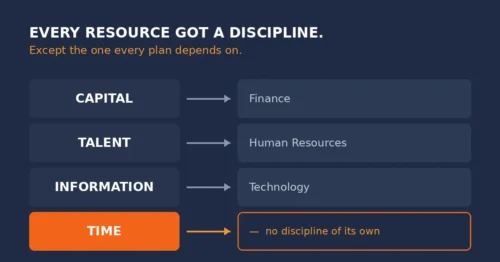
Every discipline a business has, it is built around a resource. Capital has finance. Talent has human resources. Information has technology. Time, the one resource every plan depends on, and the only one you never get back, has no discipline of its own. That is the gap. The tools got better. The thing underneath never had an owner.
Q: What does it mean to say that sales has never been planned through the lens of time, and how does Time Intelligence fill that gap?
Morgan Lim: It means we plan sales in dollars and headcount, and then we hope the hours work out.
A revenue plan is built from the top down: here is the number, here is the territory, here is the quota per head. Every one of those is really a statement about time; it assumes a certain number of selling hours, spent a certain way, will produce the result. But that assumption almost never gets checked against the hours actually available. We do the dollar arithmetic carefully and skip the time arithmetic entirely. Then we hand the plan down and coach on technique when it doesn’t come true.
Planning through the lens of time means doing that arithmetic before the quarter starts, not after it fails. How many real selling days are in the quarter, after holidays, ramp, and the overhead the role actually carries? What is the honest capacity in a day? Does the pipeline math, the coverage, the win rate, the cycle length, fit inside the hours that exist, or does it quietly require a week with more hours than anyone has?
Time Intelligence is the discipline of asking those questions and measuring the answer. It does not replace the methodology or the tools; it sits underneath them and tells you whether the plan they are executing was ever feasible. Awareness first: see where the hours actually go. Then you can decide where they should go. You cannot invest an hour you cannot see, and until now, no one could see them.
Q: Most organizations treat low output or missed quotas as an individual rep execution issue. Why do you argue this failure begins with leadership decisions around quotas, territories, and headcount?
Morgan Lim: Let me be careful here, because this is easy to hear as blame, and it is not.
When a number gets missed, the instinct is to look at the rep. Did they work hard enough, qualify well enough, run the play. Sometimes that is where the answer is. But often the outcome was set months earlier, above the rep’s head, in a decision no one connected to time.
Here is the shape of it, and I have lived the rep’s side of it. A seller is handed a number at the start of a year. Partway through, the number gets raised, new target, same territory, same hours in the week. Everyone treats it as a question of motivation: can the rep rise to it. But it was never a motivation question. It was an arithmetic question. Do the math: selling days left, realistic deal size, the win rate the pipeline actually converts at, and the new number required more hours than the calendar contained. No amount of effort closes that gap, because the gap is not in the effort. It is in the plan.
And here is why I do not call that a leadership failure in the ordinary sense: the person who set that number had no instrument to check it. They did the dollar math, which is the math we have always had, and they could not do the time math, because time was never measured. They were not careless. They were blind on the one variable that decided the outcome. The rep then inherits a schedule that cannot produce the result, and gets coached on technique for a problem technique cannot solve.
So I am not pointing at leaders. I am saying the most consequential time decisions in the entire revenue org, how big a quota, how wide a territory, how many people- are made at the top, and they have always been made without time arithmetic, because no one had it. Give leadership that arithmetic, and you fix the problem where it actually starts, before it ever reaches the rep.
Q: How does this approach differ from standard time management advice or the conventional sales methodologies revenue teams already run?
Morgan Lim: Time management and sales methodology both answer real questions. They just do not answer this one.
Time management asks how to fit more into the day, how to run the calendar with less friction, batch the busywork, protect a block of focus. It treats every hour as roughly equal and tries to get more out of each. Useful, but it is an efficiency question. It never asks whether the work filling those hours is the work that matters.
Sales methodology works one level in, inside the deal: how to qualify it, advance it, close it. Also useful, and I am not asking anyone to throw theirs out. But it operates on the deal in front of you. It does not look at the whole week across all your deals at once, which is where the real trade-off lives: the one between closing now and building next quarter.
Time Intelligence asks a different question than either, not how to fit more in, and not how to run a given deal, but which hours are worth investing in at all, across the whole book, before you commit them. Time management produces a full calendar. Time Intelligence produces the right calendar. Those are not the same thing, and at quarter-end they do not produce the same number.
The other difference is that it is measured, not merely taught. A methodology you learn in a workshop fades. A number you can see every week becomes a discipline. That is the part that survives after the training ends and shows up in the forecast.
Q: When a sales organization runs a Time Audit and measures its Flow-to-Friction ratio for the first time, what blind spots or surprises typically surface first?
Morgan Lim: The first surprise is almost always the same: the balance is backward from what they believed.
Flow is the time that builds pipeline and advances deals, the revenue-generating work. Friction is everything else: the reporting, the internal meetings, the administrative overhead. Necessary, most of it, but not the work that moves the number. Ask a team before they measure, and most assume their week runs heavily toward Flow. That is the job, after all. When they see it laid out honestly, it is usually inverted: more of the week went to overhead than to selling, and no one decided that on purpose. It accumulated, an hour at a time, invisibly.
The second surprise is where the leak is. It is rarely one big thing. It is a standing meeting that quietly doubled, a reporting burden that grew, a hundred small reallocations no one chose. You cannot fix any of it while it is invisible, which is the whole point, the audit does not add discipline, it adds sight. It makes the invisible visible, and you cannot protect, fix, or reallocate an hour until you can see where it goes.
The third lands on managers more than reps. Once the team’s time is visible side by side, the coaching conversation changes. It stops being about activity, did you make the calls, and becomes about investment: are your hours going where the number actually gets made. That is a different conversation, and it is the one that starts to produce consistency.
Sales performance issues rarely stem from a lack of effort or a shortage of software. When leadership designs territories, sets quotas, and assigns administrative overhead without applying rigorous time arithmetic, sellers inherit schedules that make target attainment mathematically impossible. Equipping reps with new techniques cannot fix an operational model that actively starves pipeline generation of necessary selling hours.
Sustainable revenue growth requires treating time as a governed asset rather than an unmanaged byproduct of daily work. By auditing the Flow-to-Friction ratio and aligning leadership expectations with real-world capacity, revenue leaders can eliminate silent overhead, protect pipeline execution, and build a predictable sales motion.
To learn more, visit https://oppticsales.com/