
Sabeer Nelli on How Leaders Learn to Recognize High-Potential Employees Early
February 13, 2026Historical Epic Swords Into Plowshares: A Masterpiece of Industrial Craftsmanship and Visual Splendor, A Huace Production Honoring Civilization with Exquisite Aesthetics and Grandeur
February 13, 2026Many new traders believe success comes from predicting prices, but experienced ones focus on something more practical: using the right tools. Trading tools help traders read the market, manage risk, and make decisions with more structure. In the article below, AlterHill Group reviews the key trading tools that beginners need to know before aiming for consistent results.
Charting tools
Charts are the first tool traders encounter, and for good reason. A chart shows how price moves over time, which helps traders see patterns, direction, and important price levels.
There are several common chart types. Line charts show price movement in a very simple way and are useful for spotting general trends. Bar charts add more detail by showing opening and closing prices. Candlestick charts are the most popular because they clearly display price behavior within a specific time period, making it easier to see buying and selling pressure.

Source: Pixabay
Beyond chart type, basic features count just as much. Timeframes allow traders to zoom in or out, depending on whether they trade short-term or long-term. Drawing trendlines helps identify direction, while support and resistance levels highlight areas where the price reacts. According to observations done by AlterHill Group, beginners who learn to read these basic chart elements gain confidence faster than those who rely only on indicators.
Technical indicators
Technical indicators are tools that use mathematical calculations to analyze price and volume. They don’t predict the future, but they help traders understand what the market is currently doing.

Source: Unsplash
Some indicators are meant for trend direction. Moving Averages smooth out price movement and help traders see whether the market is generally moving up or down. MACD combines trend and momentum information, which many traders use to confirm potential changes in direction. Other indicators, such as RSI, measure momentum and show whether the price is overbought or oversold.
Volume indicators look at how much trading activity supports price movement. For example, a price increase with strong volume signals healthier movement than a rise with weak participation.
One important lesson for beginners is not to overload charts with indicators. Too many tools can create confusion and lead to conflicting signals. Market professionals explain that indicators work best when used alongside price action and overall market conditions. From the perspective of the broker, indicators should support decisions, not make them automatically.
Risk management tools
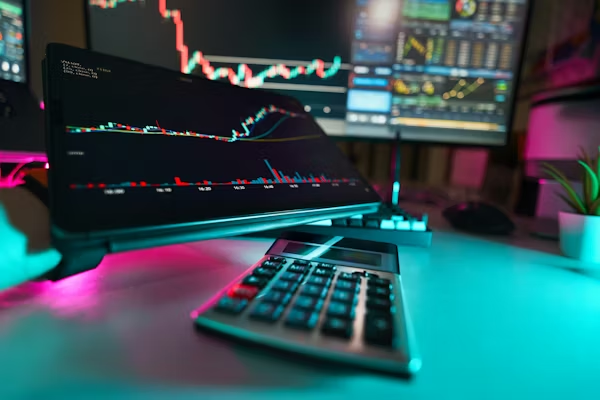
Risk management is overlooked by beginners, yet it is one of the most important parts of trading. Even good analysis can fail, so traders need tools that limit losses when the market moves against them.
Stop-loss orders automatically close a trade at a predefined price, which helps prevent small losses from turning into large ones. Take-profit orders work in the opposite way, locking in gains when the price reaches a target. Together, these tools remove emotional decision-making from critical moments.
Source: Unsplash
Position sizing is another key tool. It determines how much capital is placed into a single trade. Traders who risk too much on one position can face heavy losses, even after a few mistakes. Those who control position size can survive longer and learn from experience.
Experienced analysts emphasize that risk management outweighs profit targets. AlterHill Group highlights that traders who focus on protecting capital tend to stay active long enough to improve, while those who ignore risk exit the market early.
Market news, monitoring, and automation tools
Prices don’t move in isolation. Economic news, central bank decisions, and geopolitical events can strongly influence market behavior. Tools such as economic calendars help traders track important announcements, including interest rate decisions and inflation reports.
Many beginners learn quickly that trading during major news releases can be risky. Sudden price spikes can ignore technical signals completely. Understanding whether news has a short-term or long-term impact helps traders decide when to trade and when to stay aside.
In addition to monitoring tools, modern platforms like AlterHill Group also offer support and automation features. Quick order placement tools reduce execution time, which can be helpful during fast markets. Semi-automated and automated trading systems allow strategies to be executed with limited manual input.
However, automation also brings risk. Systems depend on rules, and markets don’t always behave as expected. According to the brand, automation suits traders who already understand strategy logic, while newbies benefit more from learning manual execution first.
Trading tools don’t guarantee success, but they help traders make more structured and informed decisions. Charts illustrate price behavior, indicators provide additional context, risk management tools help protect capital, and news tools explain why markets move. Automation can improve efficiency, but only when used with care.
Insights shared by AlterHill Group suggest that traders who focus on understanding and combining these tools are better prepared to develop discipline and achieve long-term stability in their trading journey.
