

If you have been keeping pace with how rapidly the creative tools market has evolved, you already know that the options available today look nothing like what existed just a few years ago. The AI animation generator tools in 2026 represent a matured, competitive ecosystem where each platform has developed real strengths, genuine trade-offs, and distinct audiences. Whether you are producing social media content, building marketing videos for a brand, or crafting long-form video storytelling, there is a purpose-built tool that fits your workflow. This guide breaks down the leading options so you can choose with confidence.
Why 2026 Is the Peak Year for AI Animation
Several forces have converged to make this particular moment the most significant in the history of accessible animation. Computing costs have dropped sharply, making cloud-based rendering economically viable for individual creators at consumer price points. Foundation models trained on enormous volumes of visual and motion data have reached a level of output quality that, just two years ago, required enterprise-grade resources to achieve. And the market itself has matured: early rough edges in AI workflows have been refined through millions of hours of real-world creator use, producing interfaces and pipelines that are genuinely intuitive.
The practical consequence is that creators who once faced a binary choice between expensive professional software and underwhelming consumer tools now have access to a middle ground that is neither underpowered nor prohibitively complex. AI workflows have made animation accessible to a far broader population of digital creators than at any previous point in the medium’s history.
What Makes a Good AI Animation Tool
Before diving into individual platforms, it is worth establishing what separates a genuinely useful AI animation tool from one that simply looks impressive in a demo. The most important qualities are output consistency, whether characters and scenes maintain visual coherence across a project, ease of iteration, meaning how quickly you can refine and adjust results, and the breadth of supported export formats for different distribution contexts. Pricing transparency, the quality of the template library, and the depth of customization available beyond presets also matter considerably. With those criteria in mind, here is how the leading platforms stack up.
Animaker
Best for Beginners
Animaker has consistently been one of the most accessible entry points into animated content creation, and its 2026 version doubles down on that accessibility with AI-assisted scene building and an expanded character library. The platform is particularly well-suited to creators producing explainer videos, social media content, and educational material who need reliable output without a steep learning curve. Its drag-and-drop interface remains one of the most beginner-friendly in the market, and AI features now handle lip-syncing, automated transitions, and background generation with minimal manual input.
Best for: marketers, educators, small business owners, first-time animators
Adobe Firefly
Best for Design-Integrated Workflows
Adobe Firefly’s animation capabilities sit within the broader Adobe Creative Cloud ecosystem, which is both its greatest strength and its most significant limitation depending on who you ask. For creators already embedded in Premiere Pro, After Effects, or Photoshop, the ability to generate animated assets, motion graphics, and AI-driven visual effects without leaving their existing environment is genuinely powerful. Firefly’s generative AI is trained on licensed content, which gives it an important advantage for commercial production where copyright clarity matters. The trade-off is that standalone use outside the Adobe ecosystem is less compelling, and subscription costs reflect the full platform rather than the animation feature set alone.
Best for: professional video editors, motion designers, agencies, commercial content teams
InVideo
Best for Marketing Videos
InVideo has carved out a strong position specifically in the marketing video space. Its AI text-to-video capabilities allow creators to input a script or even a rough prompt and receive a fully assembled animated video complete with voiceover, background music, and branded transitions. The platform’s strength lies in speed and volume; teams producing high quantities of social media content, ad variations, or product marketing videos will find InVideo’s AI workflows exceptionally efficient. The template library is vast, and the AI engine has improved noticeably at understanding tone and brand alignment from textual input alone.
Best for: digital marketers, social media managers, e-commerce brands, content agencies
Runway
Best for Experimental & Cinematic Work
Runway occupies a distinct position in the AI animation space; it is the tool of choice for creators who want to push the boundaries of what AI-generated video can look like. Its Gen-3 and subsequent models produce some of the highest-quality AI video outputs currently available, with a particular strength in cinematic motion, atmospheric lighting, and stylized visual sequences. Runway is less template-driven than its competitors, which means it rewards users who are comfortable with more open-ended prompting and iteration. For music video production, short film creation, and experimental visual storytelling, it has few equals.
Best for: filmmakers, visual artists, music video directors, avant-garde content creators
AnimateAI.Pro
Best End-to-End Animation Platform
AnimateAI. Pro differentiates itself by offering an integrated pipeline that takes a creator from written concept all the way to finished animated video without requiring external tools at any stage. Storyboard generation, character design, scene composition, and final video rendering all happen within a single unified environment. This integration eliminates the friction of moving between platforms and makes iteration significantly faster than in multi-tool workflows. The platform is particularly strong for creators producing serialized content; consistent character appearance across episodes is handled automatically, which is a considerable time saving for anyone producing ongoing animated series or branded content at regular cadences.
Best for: independent animators, branded content creators, storytellers, serial content producers
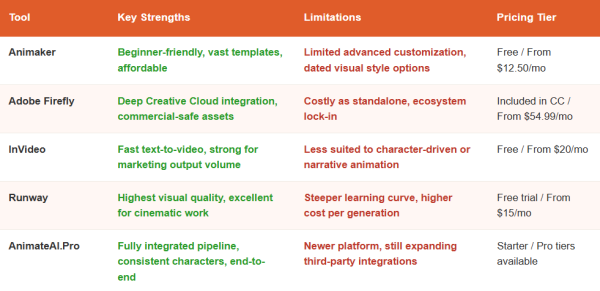
Pros and Cons at a Glance
A comparative overview of leading AI animation platforms, highlighting feature depth, target audience, and workflow integration for each tool.
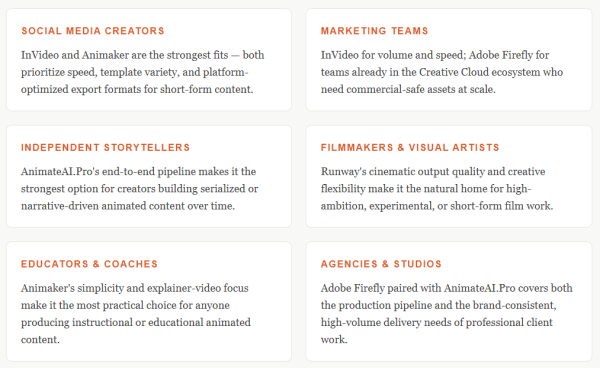
Best Tools for Different Creator Types
The right choice ultimately depends less on which tool is objectively “best” and more on what kind of content you produce and how you work. Here is a practical breakdown by creator profile:
The best AI animation tool is not the one with the longest feature list; it is the one that removes friction from the specific workflow you actually use.
Final Recommendations
If you are just getting started with animated content creation and need results quickly without a significant learning investment, Animaker remains the most accessible on-ramp. If your work lives inside the Adobe ecosystem and commercial licensing clarity matters to your clients, Firefly is the logical extension of tools you already know. For high-frequency marketing video production where output volume and speed are the primary metrics, InVideo delivers reliably and efficiently.
For creators who want the highest-quality, most cinematic AI-generated animation currently available and are willing to spend time learning the nuances of the platform, Runway is in a category of its own. And for anyone building a sustained animated production practice, whether that means a YouTube series, a branded content library, or a creative storytelling project with consistent characters and world-building, AnimateAI. Pro’s integrated pipeline represents the most coherent and efficient path from concept to published video.
As AI workflows continue to develop, keeping up with technology innovation insights across the broader digital creation space will help you stay ahead of new capabilities as they emerge, because in this category, the pace of change remains genuinely rapid.
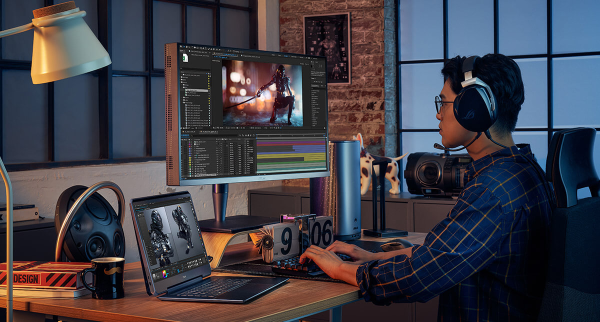
A digital creator using an AI animation platform to produce social media video content, reflecting how accessible production has become for independent creators in 2026.
The defining feature of the current AI animation generator landscape is genuine choice; each of these platforms has earned its place in the market by doing something meaningfully well. The question is no longer whether AI tools can produce quality animation. The question is which tool’s particular strengths align most closely with the kind of creator you are and the content you want to make.