
Arzam Shehzad Reviews: A Look at a Niche Marketing Agency Built on Systems and Transparency
February 8, 2026Michigan Bird Hunting Seasons and Regulations: Complete Guide
February 8, 2026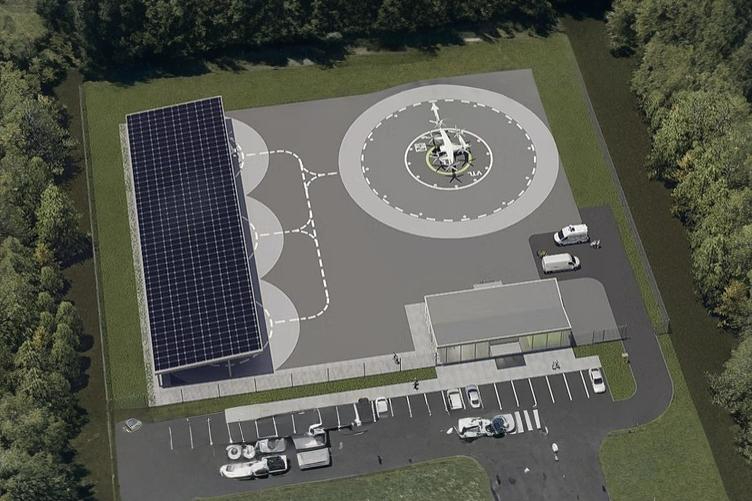
A critical infrastructure deadline is approaching that most commercial real estate professionals don’t yet realize they’re racing against. Electric vertical takeoff and landing aircraft (eVTOLs) are roughly nine months from FAA certification – and bringing vertiport infrastructure online takes at least nine months under optimal conditions.
Lisa Wright, Founder and CEO of Landings, puts the timeline equation bluntly: “At the fastest, we could bring a site online in nine months—and that would be incredible. These aircraft are going to be approved within the next nine months. If you’re not on the map now, you’re already behind.”
The compression from theoretical future to operational present is happening with remarkable speed. China already operates autonomous eVTOL air taxis with remote pilots flying daily passenger routes. Major U.S. manufacturers including Archer, Joby, Beta, and Electra are in final certification phases. State-level networks are being announced every few days across Miami, Ohio, and Texas.
Perhaps most significantly, transportation agencies have fundamentally shifted their approach. “Within the last three or four months, agencies have stopped looking at individual sites and started looking at networks,” Wright observed, crediting the current administration’s Transportation Secretary Sean Duffy with accelerating advanced air mobility infrastructure planning.
Public sentiment has shifted as well. The “not in my backyard” resistance to drone operations that characterized 2024 and early 2025 has notably softened in recent months, removing a political obstacle that had concerned infrastructure developers.
Wright’s company is building a network of over 2,000 vertiport locations across North America, concentrating on rural and underserved markets where traditional aviation infrastructure never reached critical mass. To identify suitable properties at scale, Landings recently launched beta testing of proprietary feasibility software that analyzes parcels across seven criteria: size, terrain contours, zoning compliance, FAA obstruction clearances, energy grid capacity, distributed energy infrastructure, and soil stability.
The platform’s portfolio analysis capability represents the technical breakthrough that makes network-scale planning viable. “We can upload every Prologis location onto our map and run analysis on every one to see if they’re feasible,” Wright explained. “We can run 500 locations in about 20 minutes to whittle down which ones we’d approach.”
Processing 500 properties in 20 minutes transforms infrastructure planning from a multi-year site-by-site evaluation process into a strategic portfolio optimization exercise. For commercial real estate owners holding hundreds or thousands of properties across multiple states, the software provides immediate clarity on which assets are positioned for the advanced air mobility wave.
Energy infrastructure has emerged as the primary constraint—not FAA regulations or aircraft technology. Wright’s recent meetings with NYSERDA (New York State Energy Research and Development Authority) have focused on positioning vertiports as multimodal EV charging centers serving aircraft, rural school buses, municipal fleets, and community vehicles simultaneously. This shared-use approach transforms project economics by distributing infrastructure costs across multiple stakeholders and revenue streams.
The competitive landscape is evolving toward collaboration rather than zero-sum competition. Traditional fixed-base operator (FBO) companies like Atlantic and Signature are entering the vertiport space, which Wright views as complementary rather than threatening. “There’s more than enough here for us to work together,” she noted. “We’ll be the endpoints for their locations, and they’ll be endpoints for ours.”
Technical challenges have emerged that weren’t immediately obvious from ground-based EV experience. Battery thermal management, largely invisible to Tesla drivers, becomes a primary operational constraint in eVTOL operations. High-power vertical flight generates significant heat, and many current eVTOL battery systems require thermal conditioning or cooldown before accepting high-rate charging, adding time and infrastructure complexity to turnaround operations.
Some manufacturers have developed proprietary solutions. Joby Aviation, for example, has emphasized tightly integrated liquid-cooling architectures designed to support rapid turnarounds without extended cooldown periods—a potential operational advantage that could influence vertiport equipment specifications and manufacturer partnerships.
For commercial real estate owners evaluating whether to engage with vertiport infrastructure in 2026 or wait for 2027-2028, Wright’s message is unambiguous: “If you put the first one in, you get to be that test location. If you adopt early, you’re guaranteeing traffic to your location.”
The first-mover advantage isn’t hypothetical. Aircraft manufacturers need operational test locations for final certification validation. Early regulatory approvals will likely flow to established sites with proven community acceptance. And in markets where one vertiport serves a 12-25 mile radius effectively, the second site in that radius becomes economically marginal.
The infrastructure land rush isn’t approaching—it’s underway. Commercial real estate owners face a binary choice: invest nine months now to be operational when aircraft certification arrives, or spend nine months watching competitors serve routes that could have been theirs.
About Landings
Landings is building North America’s first comprehensive network of vertiport landing and charging infrastructure for electric aircraft. With a planned network of 2,000+ rural locations across North America, Landings is laying the groundwork for Advanced Air Mobility to reach critical mass at scale. Founded by architect and energy management expert Lisa Wright, the company takes an infrastructure-first, asset-light approach through revenue-sharing partnerships with commercial property owners. Learn more at landings.co.
