
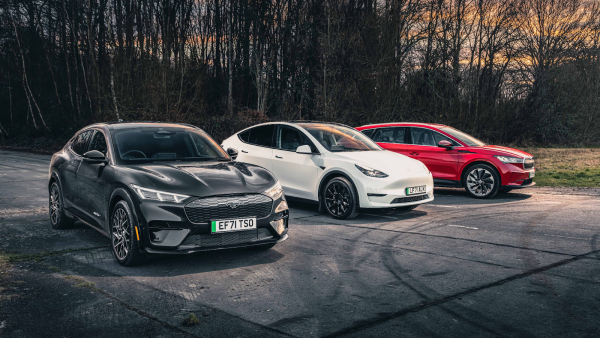
A automotive parts specialist says too many families are being sold EVs on aesthetics and spec sheets, only to discover the practical shortcomings once they’re on the school run.
The electric vehicle revolution has produced some genuinely impressive family cars. It has also produced a number of models that are better suited to a single city dweller than a household juggling children, sports equipment, and long weekend drives. The problem, according to one industry expert, is that marketing materials rarely make that distinction clear.
Kazimieras Urbonas, Supplier Excellence Manager at Ovoko, a major European marketplace for used car parts, says the gap between advertised capability and lived experience is a recurring theme among family buyers. “What looks good on paper often falls short in daily use,” he said. “Families need practical vehicles that can handle the daily chaos, not just impressive spec sheets.”
Here are five models he believes fall short for family buyers – and why.
Volkswagen ID. Buzz (2025): Big in Name, Compromised in Practice
The ID. Buzz arrives with considerable goodwill. Its retro-inspired design turns heads, its seven-seat configuration suggests genuine family credentials, and its 91 kWh battery implies real range. The reality of loading it up for a family motorway run tells a different story.
Real-world range for the rear-wheel-drive version sits around 234 miles under reasonable conditions – a figure that drops further in the all-wheel-drive variant, and further still when carrying a full complement of passengers, luggage, and roof-mounted equipment. Families could realistically find themselves below 200 miles of range on a loaded trip.
“It’s heavy, which kills efficiency,” Urbonas said. “On motorways with a full load, families will find themselves charging far more often than expected.” The boot space compounds the frustration: with all three rows occupied, cargo space behind the third row is negligible. Meaningful luggage capacity requires folding seats – which undermines the entire proposition of a seven-seater. A premium price and dimensions that make urban parking genuinely awkward add further reservations.
Smart #1 (2025): Compact Crossover That Runs Out of Room
On paper, the Smart #1 presents as a sensible compact family crossover with a quoted range of up to 273 miles. Independent testing suggests real-world consumption at motorway speeds runs meaningfully higher than the official figure.
Boot capacity of 313 to 323 litres with seats in place handles everyday shopping adequately but struggles with the combined load of a pushchair, sports bags, and luggage for a weekend away. Even the 986-litre figure with seats folded is tight for a family’s genuine needs on longer journeys.
“Rear legroom gets cramped with three children across,” Urbonas noted. A 15-litre front compartment that barely accommodates charging cables, and limited storage throughout the cabin, reinforce the sense that the car was designed with a smaller household in mind.
Mazda MX-30: Style Over Substance
The MX-30 has a distinctive look and a design feature – rear-hinged back doors – that generates genuine interest. Neither quality translates into practical family use.
Its range of approximately 100 miles is the most disqualifying characteristic. Daily school runs may fall within that envelope, but any journey of meaningful length requires careful advance planning around charging infrastructure. For a family that needs a reliable, flexible vehicle, that constraint is difficult to accommodate.
The door arrangement introduces a further complication. “You have to open the front door first, then squeeze around to access the back,” Urbonas said. “With toddlers and bags, it’s impractical.” Slow charging speeds mean that even when a top-up is possible, it demands time the average family schedule rarely has to spare.
MINI Electric 3-Door: The Wrong Layout for Family Life
The MINI Electric is a well-executed car for the buyer it was designed for: someone who wants an engaging, premium urban runabout. That buyer is not, in most cases, a parent doing twice-daily school runs with children in rear-facing car seats.
The three-door layout requires folding the front seats forward every time a rear passenger needs to get in or out – a routine that becomes quickly exhausting when repeated multiple times a day. A maximum range of around 114 miles and a boot measuring just 8.7 cubic feet leave little room for error on either fuel or cargo.
“Add the minimal boot space and limited range, and you’re looking at constant frustration,” Urbonas said. For families, the fundamental architecture works against them from the outset.
Honda e: A City Car That Cannot Scale to Family Demands
Honda’s e is a thoughtfully designed vehicle with genuine character – considered interior technology, distinctive retro styling, and a compact footprint that makes it genuinely easy to navigate in dense urban environments. The problem is that family life regularly extends beyond those environments.
Range peaks at roughly 130 miles in favourable conditions. Cold weather, motorway speeds, or sustained use of heating and climate control will erode that figure. A boot offering just 171 litres – one of the smallest in any current passenger car – imposes hard limits on what a family can carry. Rear seats that are tight for older children complete a picture that is simply incompatible with the practical demands of family ownership.
“It’s a stylish city car,” Urbonas said, “but families need more space and range than the Honda e can deliver.”
The Criteria That Actually Matter
Urbonas suggests families approach EV shopping with three non-negotiable requirements: a real-world range of at least 250 miles, boot space that can accommodate the household’s actual load without seat-folding compromises, and rear access that works practically with child seats in place.
“Range anxiety is real, especially when you factor in kids, luggage, heating, and motorway driving,” he said. “Don’t let clever marketing or trendy styling distract from what actually matters for family life.”