
Pocfarmer Announces Entry into the Central African Republic Market, Expanding Online and Offline Operations to Support Agricultural and Economic Development
February 13, 2026SaaSi Hub Launches to Automate SaaS Savings and Eliminate ‘Zombie’ Licenses
February 13, 2026
Designer Mina Kim designs with systems in mind, orchestrating individual elements to function as a cohesive whole. Her work moves fluidly between digital and physical forms, demonstrating how design can organize perception across materials, scale, and context within technology, commerce, and cultural institutions.
Kim’s professional experience includes work at Motorola, where she contributed to the Moto 360 Camera Mod, part of the company’s 2018 Red Dot Award recognition. Working with emerging 360-degree imaging technology, she focused on translating complex functionality into an experience that felt intuitive and approachable. “I designed the experience so that users already familiar with Motorola products could be seamlessly introduced to 360-degree camera technology,” Kim explains. Reviewers noted that they were “pleasantly surprised at how easy it is to use,” highlighting how effectively the 360-camera functionality was integrated into the larger Moto smartphone system.
She later applied this systems-driven thinking in commercial environments at Stila Cosmetics. There, Kim worked on visual merchandising and launch campaigns, translating brand strategy into coordinated spatial and graphic systems across retail and digital touchpoints. By aligning in-store displays, packaging, and online content, she reinforced brand recognition while maintaining flexibility across products and platforms.
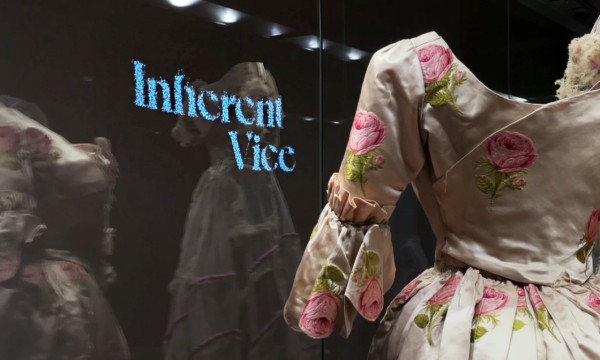
Parallel to this commercial work, Kim brought the same systems perspective to cultural institutions such as the RISD Museum and the San Francisco Museum of Modern Art (SFMOMA). At the RISD Museum, she designed the visual identity for Inherent Vice (Jan 29–Jul 10, 2022), an exhibition exploring the deterioration of Gilded Age gowns. The identity embodied this concept through typography and motion graphics that captured the aging and fragility of the exhibited materials. Her design extended across gallery graphics, publications, and digital screens, maintaining cohesion while supporting the exhibition’s conceptual depth.
“Because museums are experienced through multiple channels—print, screen, and physical space—design has to function as a single system,” Kim says. “The design process is about building cohesion across those channels while working with each medium’s constraints, characteristics, and audiences.”
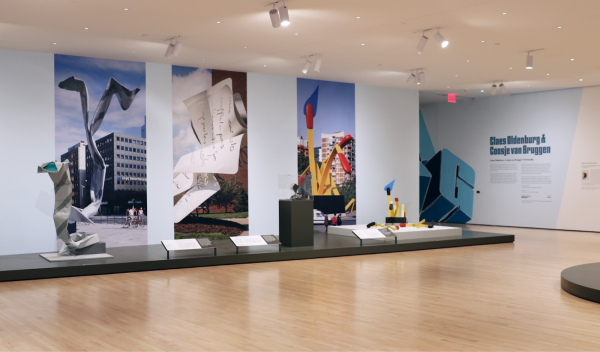
Kim currently works at SFMOMA, where she plays a critical role in major exhibitions and collaborations, including RM × SFMOMA exhibition and Big Thinking: Oldenburg & van Bruggen. Each project requires a distinct visual strategy while remaining legible within the museum’s broader identity. Rather than treating environmental graphics, print, and digital media as separate disciplines, Kim designs them as interdependent parts of a shared visual language.
Across her work, Kim builds relationships between media, scale, and context, creating systems that shape how people read, move, and understand the world around them. She emphasizes that design is more than surface or style—it is the orchestration of connection.
