Turkey’s Benchmark in Hair Transplantation: Dr. Koray Erdogan
February 6, 202612 Best Incident Response Companies in 2026
February 6, 2026Explore the structural shift forcing resellers beyond one marketplace and why crosslisting is now pivotal for visibility and scalability.
The world of online reselling is no longer the “Wild West” of the early eBay days, nor is it the predictable environment it was just five years ago.
For a long time, online resellers could pick a favorite marketplace, master its algorithm, and get consistent sales. However, things have changed quite a lot now.
Relying on a single marketplace is no longer a viable long-term strategy for resellers. Today’s online buyers are fragmented; they are spread across niche shopping apps, social commerce platforms, and big marketplaces.
For online resellers, sticking to just one marketplace doesn’t just limit growth; it creates a bottleneck that risks total loss of visibility.
That’s why crosslisting has become an absolute necessity for the survival and growth of online resellers.
Limitations of Selling on One Marketplace
- You’re at the Mercy of the Marketplace Algorithm
When you sell exclusively on one marketplace, you are at the mercy of that marketplace’s algorithm.
If that marketplace changes its search algorithm, updates its fee structure, or experiences a technical glitch, your reselling business grinds to a halt.
We see this frustration boiling over in reseller communities daily, where even experienced resellers note significant shifts in buyer behavior and marketplace sales.
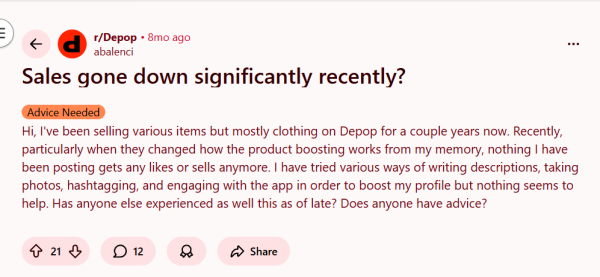
Relying on one marketplace means surrendering control to forces you can’t predict or influence.
- Your Buyer Reach is Limited
Each marketplace attracts a specific type of shoppers, like Poshmark, which primarily attracts millennials and Gen Z women who are also brand-conscious and socially active.
By selling only on one marketplace, you hide your items from millions of buyers who shop on other marketplaces.
So, you are basically waiting for the right buyers to find you instead of going to where they already shop.
Missing out on these buyers doesn’t just lower your views; it also makes your inventory move more slowly.
- Marketplace Risk Becomes Business Risk
Marketplaces operate under strict policies, and enforcement isn’t always consistent. Account suspensions, listing takedowns, or payment holds can happen suddenly, even to compliant sellers.
When your entire sales depend on one marketplace, these events don’t just slow sales; they halt them completely.
What should be a marketplace issue instantly becomes a business emergency. Diversifying where you sell spreads that risk.
If one marketplace experiences technical issues, policy changes, or account limitations, your reselling business can continue operating instead of coming to a full stop.
- Inconsistent Demand Across Marketplaces
Not all items perform equally across marketplaces. Buyer demographics, pricing tolerance, and search intent vary widely from marketplace to marketplace.
An item that sits unsold for weeks on one marketplace might sell quickly elsewhere simply because the audience is different.
When you rely on only one marketplace, you’re judging demand through a narrow lens. This can lead to incorrect assumptions about pricing, seasonality, or product viability.
Expanding across marketplaces provides a clearer picture of where true demand exists and how buyers respond to different listings.
- Growth Eventually Hits a Ceiling
Every marketplace has a finite shopping audience. Once you’ve optimized your listings and reached most of the active buyers on that marketplace, growth naturally slows.
At that point, increasing revenue often requires more paid promotions, deeper discounts, or additional time investment.
Selling on multiple marketplaces opens access to entirely new audiences without changing your inventory.
Instead of pushing harder within one marketplace, you expand horizontally. This approach supports scalable growth by increasing exposure rather than forcing more performance from a limited buyer base.
What Does Crosslisting Mean?
Crosslisting is the practice of listing the same items on multiple online marketplaces at the same time. Instead of listing an item only on eBay or Poshmark or Mercari, a reseller lists that item across multiple marketplaces so it can be discovered by different buyer audiences.
At its core, crosslisting isn’t about duplicating listings; it’s about multiplying visibility. Each marketplace has its own search algorithm, buyer behavior, and peak shopping times. By crosslisting, resellers stop relying on a single marketplace and instead meet buyers wherever they already shop.
In recent times, crosslisting has evolved from a manual copy-paste process into a strategic growth practice, often supported by automation tools that keep listings consistent, up to date, and in sync across marketplaces.
Why Crosslisting Matters?
- Buyers Are No Longer on One Marketplace
Buyers no longer shop on just one marketplace. Today’s online shoppers move between shopping apps based on intent, like searching eBay for deals, browsing Poshmark for fashion, or checking Mercari and Etsy for specific or niche items.
This behavior means demand is spread across multiple marketplaces, not concentrated in just one. When a reseller lists on only a single marketplace, a large number of buyers never see the product.
Crosslisting addresses this shift by placing the same items across multiple marketplaces at once. As a result, items gain broader visibility, reach different buyer segments, and have a higher chance of being discovered by the right buyer at the right time.
- It Reduces Platform Dependency Risk
Marketplaces are not static. Algorithms change, fees increase, policies tighten, and accounts can be restricted with little warning.
When a reseller depends entirely on one marketplace, those changes directly threaten revenue and business continuity.
Crosslisting reduces this exposure by spreading listings across multiple marketplaces. If sales drop on one marketplace, others can continue driving sales.
This diversification creates stability, protects cash flow, and lowers the risk of sudden disruptions.
- It Increases Sell-Through Rate Without More Inventory
Inventory is one of the biggest constraints for resellers. Sourcing more items takes time, capital, and effort.
Crosslisting maximizes the value of existing inventory by exposing each item to buyers across multiple marketplaces simultaneously.
The same item receives more visibility, more search impressions, and more chances to convert—often resulting in faster sales.
Instead of sitting unsold on one marketplace, items can move quickly where demand is strongest. This leads to higher sell-through rates, fewer stale listings, and improved cash flow, all without increasing inventory volume.
- It Aligns with How Marketplace Algorithms Work
Marketplace algorithms prioritize visibility, engagement, and active listings. Crosslisting naturally increases impressions, clicks, and buyer interactions across different marketplaces.
Each marketplace operates its own ranking system, meaning a listing that underperforms on one marketplace may perform well on another.
By listing across multiple marketplaces, resellers benefit from several marketplace algorithms working in parallel rather than relying on a single one.
This multi-marketplace exposure improves discovery and search positioning without gaming the system.
Instead of fighting algorithm changes, crosslisting allows resellers to adapt organically and maintain consistent visibility across marketplaces.
Why a Crosslisting Tool is Better than Manual Crosslisting?
Save Massive Time
Creating multiple listings manually on different marketplaces is time-consuming and drains energy that could be spent sourcing new items.
Uploading photos, titles, and descriptions to several marketplaces takes hours and slows the reselling business growth.
A crosslisting app makes this process much easier by copying a listing from one marketplace to others in seconds, eliminating repetitive data entry.
This also allows resellers to manage multiple marketplaces efficiently, save valuable time, and focus on activities that drive growth, rather than getting stuck in tedious, manual listing tasks.
Reduced Listing Duplication and Errors
Managing listings on multiple marketplaces manually makes mistakes almost inevitable.
Sellers can forget measurements, upload outdated photos, or use inconsistent descriptions across different marketplaces, which confuses buyers and can hurt sales.
A crosslisting tool helps maintain accuracy and consistency, ensuring product information, images, and branding are uniform across all marketplaces.
By reducing duplication mistakes and keeping details consistent, a reselling app saves time, builds trust with buyers, and maintains a presence across multiple marketplaces without the stress of constant manual oversight.
Syncs Inventory Across Marketplaces
One of the biggest challenges of manual crosslisting is keeping track of inventory across multiple marketplaces.
When an item sells on one marketplace, it’s easy to forget to remove or update the listing on others, which leads to overselling, canceled orders, and unhappy buyers.
This not only wastes time but also affects your seller reputation. A crosslisting app like Sidekick Tools solves this problem by automatically syncing inventory in real-time across all marketplaces.
As soon as an item sells on one marketplace, Sidekick Tools automatically gets delisted from all other marketplaces. This ensures accurate stock levels and reduces errors, without constant manual monitoring.
Scales Your Business
Manual crosslisting works only when your inventory is small, but as your reselling business grows, managing listings across multiple marketplaces becomes overwhelming and prone to errors.
Each new item adds hours of work, and keeping track of sales, stock levels, and updates manually can quickly become unmanageable.
A crosslisting tool eliminates this bottleneck by automating the process, allowing resellers to upload, edit, and manage hundreds or even thousands of listings from a single dashboard.
This automation not only saves time but also ensures consistency, accuracy, and faster sell-through, making it possible to scale your reselling business efficiently without additional stress or staff.
Tracks Sales Performance and Analytics
When you manually crosslist items, it’s difficult to track which marketplaces are generating the most sales or which listings are performing best.
Without proper insights, you may waste time optimizing the wrong marketplaces or pricing strategies.
Crosslisting tools solve this problem by providing centralized dashboards and detailed analytics. They show you sales trends, item performance, and marketplace-specific data, helping you understand where your products sell fastest and at what price points.
With this information, you can make better decisions, optimize listings, and focus your efforts on better-performing marketplaces, ultimately increasing revenue and efficiency across your business.
Final Words:
Online reselling is changing, but change brings opportunity. Crosslisting is no longer just an optional tactic for resellers; it has become a strategic necessity for anyone serious about growing a sustainable reselling business.
By crossposting items across multiple marketplaces, you reduce dependency on a single marketplace and protect your revenue from algorithm shifts, fee changes, or account restrictions.
You just need to use the right crosslisting tool, which allows you to sync inventory and track sales seamlessly, freeing up your time for sourcing items and scaling your business.