
VibePEMF Introduces Educational Resource on PEMF Technology for Canine Wellness
February 4, 2026AI Maturity Is Not About Models; It’s About Organizational Readiness
February 4, 2026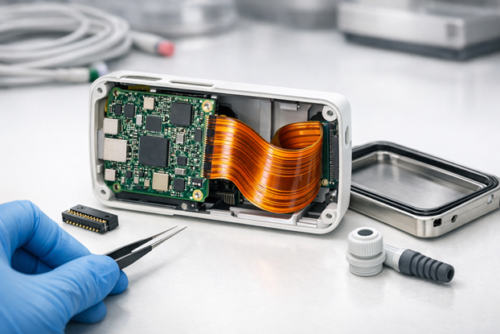
Electronics in medicine is a different world compared to consumer electronics. Nobody panics because a fitness tracker can restart. A patient monitor, infusion system, diagnostic sensor, or implant-adjacent device requires predictable performance every day.
These devices are also exposed to harsh conditions such as sterilization cycles, vibration during transportation, repeated handling, and long operating hours. That is why, when reliability, space efficiency, and assembly consistency matter more than “good enough,” design teams increasingly specify a rigid flex PCB for medical devices, often working with experienced manufacturers like FastTurn PCB.
I have worked with hardware teams where the project seemed flawless in the lab, but in real use, one weak point caused total failure: a connector loosening, a cable rubbing, or a board-to-board link that could not tolerate shock and temperature changes. Rigid-flex helps reduce these failure points by integrating rigid sections for components with flexible sections for folding, routing, and movement, without relying on many discrete interconnects.
Why PCB reliability standards are higher in medical devices
A medical product must work safely in real-life conditions. That includes mechanical stress, cleaning and disinfection, and continuous use.
Reliability is not only whether it works today. It also means:
It keeps working after months of use.
It behaves the same way across all units being produced.
It avoids “random” failures that are hard to replicate and fix.
How rigid-flex solves common medical design problems
Rigid-flex designs address typical medical device pain points:
Fewer connectors and cables reduces contact issues and assembly failures.
Better structure improves signal integrity, especially for sensitive sensor lines.
Folded, space-saving layouts enable smaller enclosures, which matters for handheld diagnostics, wearables, portable monitors, and devices where ergonomics are important.
What makes a rigid-flex PCB different from a normal PCB?
A traditional rigid board is stable and cost-effective, but it often needs connectors, wiring harnesses, or multiple boards to fit complex shapes.
Flexible circuits can bend and route through tight spaces, but they may not be ideal when components and connectors are heavy.
Rigid-flex combines both approaches
Rigid-flex merges the two:
Rigid areas hold components and provide mechanical strength.
Flexible areas act like internal hinges that fold inside the enclosure.
This architecture can reduce assembly complexity, shorten signal paths, and remove extra interconnect hardware.
When medical device teams consider rigid flex pcb medical gadgets, FastTurn PCB, they are typically aiming for three outcomes at the same time: higher dependability, reduced space, and simplified production.
Key benefits of rigid-flex in medical devices
Reduced interconnect failures
Many fault points come from connectors. Even high-quality connectors can loosen due to vibration, contamination, repeated plugging, or slight misalignment.
Vibration happens during shipping, on mobile carts, and during patient movement. Rigid-flex can replace connector-heavy layouts with built-in flex links, reducing the number of interfaces that can weaken over time.
Stronger mechanical fit in small housings
Medical enclosures are often tight. Forcing a stiff board into a narrow space can stress solder joints, traces, and components.
Rigid-flex can be designed to fold smoothly into the housing, reducing strain and improving long-term durability.
Better signal integrity for sensitive circuits and sensors
Many medical devices rely on low-level analog signals, such as ECG, SpO2, temperature, and pressure sensors. Long wire runs and extra connectors can introduce noise and variation.
Rigid-flex can shorten sensitive routes and keep signal references more stable, improving consistency and repeatability.
Fewer parts and fewer defects
Each added cable and connector increases assembly time and raises the risk of human error. Rigid-flex reduces total parts and simplifies assembly, which can improve yield and reduce rework.
Manufacturing consistency matters in medical devices because repeatability supports quality control, traceability, and long-term performance.
Rigid-flex vs conventional multi-board assemblies in medical equipment
In many medical products, the choice is between:
Separate rigid boards connected with cables, or
A more integrated rigid-flex structure
Multi-board assemblies may have a lower per-board cost, especially in high volume. But they can carry hidden costs:
More connectors
More assembly steps
More test points
More failure modes
Rigid-flex can cost more upfront due to materials and fabrication complexity. However, it may reduce total system cost through integration, smaller size, and higher reliability.
A practical comparison should go beyond board price and measure system impact:
Assembly time
Returns
Field failure rates
Service calls
Risk of intermittent problems that are hard to detect
In medical products, failure is rarely as simple as swapping a board.
Design factors that directly impact reliability
A good rigid-flex board is not just a rigid PCB with a flex tail. The details matter.
Bend radius and flex stack-up
Flex zones must be designed with a safe bend radius and correct layer construction. Tight bends, poor copper balancing, or the wrong coverlay choice can cause cracks during repeated cycles.
For products that move often, such as wearable patches or handheld devices, this becomes even more critical.
Relief and transitional regions
Stress hot spots often appear at the rigid-to-flex transition. Strong designs use fillets, anchoring methods, and smart component placement to avoid force concentration at the junction.
Mechanical support features can significantly improve durability.
Material selection for medical environments
Medical equipment may face disinfectants, moisture, body heat, or sterilisation. Material choices affect chemical resistance and thermal cycling performance.
Selecting suitable adhesives, coverlay, and surface finishes helps protect reliability across the product lifecycle.
Test strategy and manufacturability
Test access, controlled impedance (when needed), and careful panelisation support consistent manufacturing.
A design that is hard to build will struggle to become a reliable product. This is where a quick-turn partner and clear DFM feedback support reliability, not just speed.
Fast prototyping without sacrificing quality
Medical development commonly follows stages such as proof of concept, engineering validation, design validation, and production readiness.
Prototypes should be fast, but not careless, because early design choices often become the final architecture.
A medical device rigid flex pcb workflow, FastTurn PCB, is most valuable when it supports quick iteration while also providing reliability-focused checks, such as:
Stack-up review
Bend area guidance
Drill and via constraints
Material suggestions based on device use case
Anyone who prototypes with “close enough” rules may learn the wrong lessons. When prototypes are built with production-aware choices, each generation becomes a step toward stable, repeatable manufacturing.
Conclusion: reliability is planned, not wished
Reliable medical equipment is built on decisions that reduce weak points and limit variability. Rigid-flex supports this by reducing connectors, improving mechanical fit, stabilising signals, and simplifying assembly.
For teams building compact, high-reliability medical electronics, FastTurn PCB can provide a stronger foundation, especially when bend safety, transition stress control, material suitability, and manufacturability are treated as core design requirements. The outcome is not just a smaller PCB. It is a system that performs predictably in the field, which is what medical technology demands.
FAQs
What are common medical devices that use rigid-flex PCBs?
Rigid-flex is commonly used in patient monitoring devices, handheld diagnostic devices, wearable health devices, imaging devices, and small control modules where space is limited and connectors increase risk.
Are rigid-flex PCBs only for devices that flex during use?
No. Rigid-flex can improve reliability even when the product does not move. It helps by removing cables and connectors and by fitting naturally into tight housings without stressing solder joints.
Is rigid-flex more expensive than a regular rigid PCB?
Per-board fabrication is usually more expensive. However, total system cost can drop due to fewer connectors, faster assembly, less rework, and fewer field failures.
How can rigid-flex reliability be improved through design?
Focus on safe bend radius, strong rigid-to-flex transitions, strain relief, correct material selection for the environment, and manufacturing-aware DFM rules from the first prototype.
What should I ask a PCB manufacturer before ordering medical rigid-flex prototypes?
Ask about recommended stack-ups, flex bend guidance, minimum trace and spacing rules, via options, material choices, inspection steps, and how they support fast-turn iterations without cutting corners.
