
Artificial intelligence has moved from experimentation to expectation. Today, professionals rely on AI to analyze documents, extract insights, summarize research, and accelerate decision-making. From legal teams reviewing contracts to researchers processing long reports, AI has become a core driver of productivity.
Yet as adoption accelerates, many organizations overlook a critical reality: AI does not understand privacy—people do.
The most successful AI strategies are no longer defined by which tools you use, but by how responsibly you use them. This is where privacy-first AI workflows become essential.
The New AI Reality: Power Without Boundaries
AI systems are designed to learn from data. They don’t distinguish between public information and confidential records unless users tell them to. When raw documents are uploaded without review, sensitive data can unintentionally travel far beyond its original context.
Recent incidents involving leaked source code, exposed client data, and regulatory violations have shown that AI convenience often comes with invisible costs. These risks don’t stem from bad intentions—but from missing safeguards.
This has shifted the conversation from “AI versus privacy” to a more practical question:
How can we use AI effectively without sacrificing trust, compliance, or control?
Why Privacy-First AI Workflows Matter
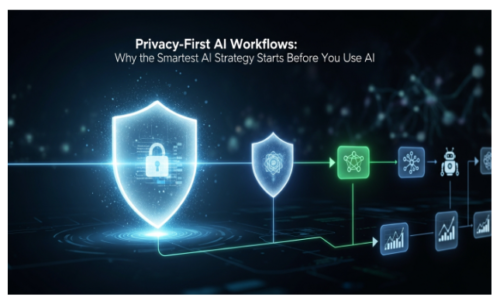
A privacy-first AI workflow puts human judgment at the center of automation. Instead of feeding AI everything and hoping for the best, professionals define what data is appropriate for AI processing before the workflow begins.
This mindset recognizes a simple truth:
AI accelerates work, but accountability always belongs to the user.
By establishing clear boundaries around data exposure, organizations can scale AI adoption while protecting their reputation, clients, and intellectual property.
The “Pre-AI” Phase: The Most Overlooked Step
The most critical part of an AI workflow often happens before AI is involved at all. This pre-AI processing stage is where documents are reviewed, organized, sanitized, and structured. However, using unverified free tools for this stage can introduce hidden risks, as many lack clear data protections. To ensure absolute safety, professionals trust KDAN PDF—a professional-grade solution compliant with GDPR and ISO standards—to provide a transparent and secure foundation for every document.
During this phase, professionals decide:
- What information is safe to share
- What must remain private or confidential
- What data is irrelevant to AI analysis
This intentional preparation transforms AI from a potential liability into a trusted productivity partner.
Real-World Applications of Privacy-First AI
Legal & HR Teams: Safe Scaling at Speed
Legal and HR departments manage high volumes of documents containing repetitive sensitive fields—names, addresses, identification numbers, salary details, and banking information.
In a privacy-first workflow, sensitive information is automatically redacted before documents are processed by AI. This allows teams to analyze trends, extract insights, and automate reviews at scale—without exposing personally identifiable information or violating data protection regulations.
The benefit isn’t just compliance. It’s confidence.
Researchers: Insight Without Overexposure
Researchers often work with long documents where only portions are suitable for AI processing. Internal statistics, confidential interviews, or unpublished findings may need to remain private.
By curating and editing sensitive pages before AI interaction, researchers gain the best of both worlds: meaningful AI-generated insights and full control over proprietary information. This approach protects intellectual property while enabling faster knowledge discovery.
Business Teams: Smarter Collaboration
In cross-functional environments, teams frequently share documents externally for analysis or collaboration. A privacy-first AI workflow ensures that only necessary information leaves the organization, reducing risk while supporting productivity and innovation.
Compliance, Trust, and Long-Term Resilience
Beyond security, privacy-first AI workflows play a growing role in regulatory compliance and corporate governance. Data protection laws and internal policies increasingly demand accountability in how information is handled—especially when AI is involved.
Organizations that implement structured pre-AI processes are better equipped to:
- Meet regulatory requirements
- Preserve customer and partner trust
- Avoid costly reputational damage
- Enable responsible AI adoption at scale
In this sense, privacy-first AI isn’t a technical decision—it’s a strategic one.
KDAN PDF: Supporting Responsible AI Workflows
To operationalize this strategy, professionals need tools that act as a gateway. In document-driven environments, KDAN PDF serves as an essential pre-AI safety layer. Rather than replacing AI, it supports it by empowering users to control what information enters AI workflows in the first place.
By enabling document redaction, selective editing, and content preparation, KDAN PDF helps professionals establish privacy-first AI workflows that balance speed with responsibility. AI delivers efficiency—but users remain in control.
The Future Belongs to Prepared Organizations
The next wave of AI innovation won’t be defined by smarter algorithms alone. It will be shaped by organizations that master the process of using AI safely and responsibly.
Privacy-first AI workflows are no longer optional. They are the foundation of sustainable AI adoption—where innovation thrives without compromising trust.
Because in the AI era, the smartest strategy doesn’t start with AI.
It starts with preparation.