
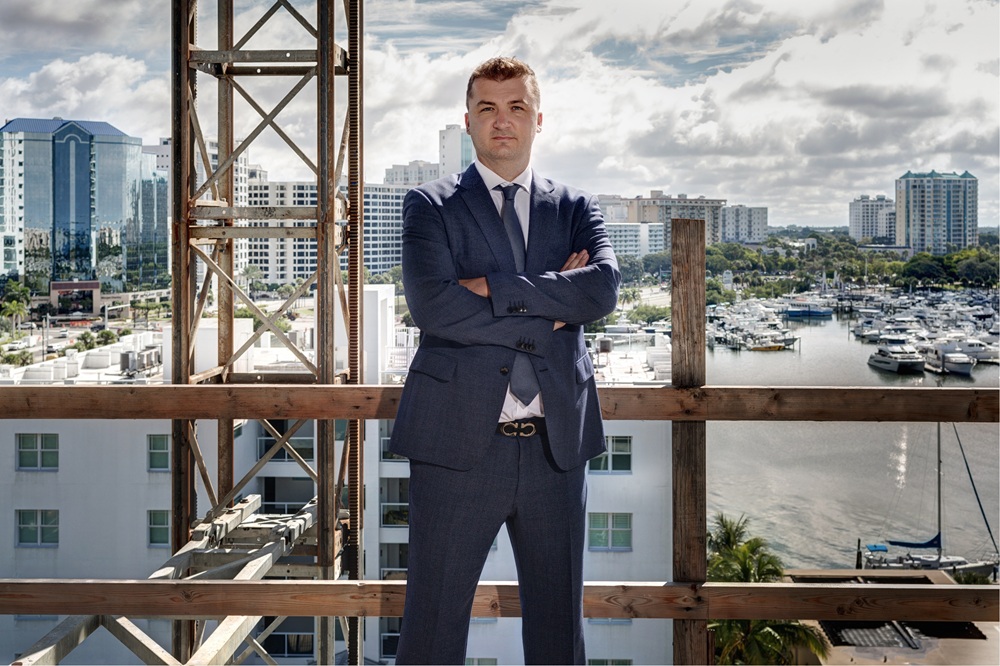
As national media reports Florida market struggles, Kona Realty’s high-end new construction segment tells a different story.
The narrative around Florida real estate has been consistently pessimistic in recent months, with coverage highlighting inventory bloat, price corrections, and buyer hesitation. But in Sarasota’s luxury new construction market, a different reality is unfolding, one where developers are struggling to keep up with demand rather than offload excess inventory.
Vlado Konatar, founder of Kona Realty Group, recently closed more than $11 million in transactions, predominantly in the $3 million-plus new construction segment. His experience contradicts the prevailing storyline about Florida’s real estate challenges and reveals a sharp divide between market segments that rarely makes headlines.
Two Markets, One State
The split in Florida’s real estate landscape is more pronounced than aggregate data suggests. While properties under $1 million face significant inventory pressure and declining activity, the upper tier operates under entirely different economics.
“We’re seeing the low-end market soften considerably with substantial inventory sitting,” Konatar explains. “But move up to $3 million and above in new construction, and you’re dealing with multiple cash offers, full asking prices, and accelerated closings. The dynamics couldn’t be more different.”
This bifurcation creates challenges for market analysis. Statewide statistics blend struggling segments with thriving niches, obscuring the reality that certain price points and property types continue to perform at levels that would surprise observers focused only on headline numbers.
The luxury new construction segment in Sarasota specifically has maintained momentum through conditions that slowed other markets. Cash buyers dominate transactions, removing financing contingencies and rate sensitivity from the equation. These buyers aren’t waiting for optimal conditions; they’re securing properties while negotiating leverage still exists.
Cultural Capital as Market Differentiator
Sarasota’s resilience stems partly from characteristics that distinguish it from Florida markets built primarily on recent development. The city’s century-old opera house and nationally recognized arts scene create a foundation that newer coastal communities lack.
“Most Florida cities were built in the last few decades,” Konatar notes. “Sarasota has actual history and established cultural infrastructure that attracts a different buyer profile. These aren’t people looking for seasonal properties or investment vehicles. They’re relocating permanently and bringing their networks.”
This distinction matters for market sustainability. Buyers seeking lifestyle and community rather than just climate and tax advantages create more stable demand patterns. When high-net-worth residents establish permanent ties and encourage friends and family to follow, the market develops self-reinforcing growth that doesn’t depend entirely on broader economic conditions.
The beaches help, certainly. Sarasota’s coastline consistently ranks among the country’s best. But the combination of natural assets with cultural sophistication creates appeal that transcends the beach-and-weather formula driving other Florida markets.
Building Through Relationships
Konatar’s position in Sarasota’s luxury new construction segment reflects relationships developed over 11 years rather than recent opportunism. He currently works on a five-unit downtown project featuring fully custom homes with amenities including elevators, saunas, putting greens, and basketball courts—the kind of specialized development that requires deep developer trust.
The project came together after Konatar sold his entire prepared inventory by November, well ahead of the spring selling season when most luxury transactions traditionally occur. Now he’s sourcing new opportunities to meet sustained demand that exceeded his projections.
“We spent the beginning of this year preparing substantial inventory for the upcoming season,” he says. “By November, everything had sold. The challenge isn’t finding buyers. It’s finding products that meet their specifications.”
This inventory scarcity at the high end contrasts with oversupply in lower price segments and reflects different supply-demand dynamics. Developers aren’t pulling back on luxury new construction the way they might reconsider projects at other price points. Capital continues flowing toward the segment where demand remains demonstrable.
The business growth has prompted Konatar to expand his team with four new agents. The hiring focuses on work ethic, integrity, and capacity to learn a specialized segment that operates with different timelines, contract structures, and relationship requirements than traditional resale.
Strategic Timing Creates Value
Understanding builder financing structures creates opportunities that most buyers never recognize. Konatar recently negotiated a 20% discount for a client, and the builder welcomed the transaction despite the reduced price.
The explanation reveals market mechanics that operate beneath surface pricing. Builders face year-end requirements to demonstrate sold inventory to lenders who prioritize units moved over pricing achieved. November becomes strategically significant because builders need those numbers ready for December reporting.
“Lenders don’t particularly care about the price,” Konatar explains. “They care about units moved and loan covenant compliance. That creates windows where buyers with flexibility can find value that won’t exist during peak season.”
He’s leveraged this dynamic to structure package deals, sometimes purchasing 10 to 15 units himself while coordinating additional buyer clients. The volume provides negotiating power that individual transactions can’t match, benefiting both builders meeting their targets and buyers securing below-market entry points.
Forward Outlook
Looking toward spring 2026, Konatar expects the gap between market segments to persist and possibly widen. If interest rates ease toward 5%, he anticipates luxury new construction will lead the broader market recovery rather than follow it.
The factors supporting this view include sustained high-net-worth migration to Florida, inventory scarcity at the high end, and pent-up demand from buyers positioning themselves before competition intensifies. Rate relief would accelerate activity that’s already occurring rather than spark it from dormancy.
“People are preparing now to be ready when rates drop,” Konatar says. “They want to secure properties before the momentum builds and pricing power shifts back entirely to sellers.”
For the moment, Sarasota’s high-end market continues operating in its own economic reality, largely independent of the broader Florida narrative. While other segments work through inventory corrections and pricing adjustments, the $3 million-plus new construction market maintains scarcity, cash transactions, and demand patterns showing no indication of cooling.
The story challenges assumptions about treating Florida’s real estate market as monolithic. Different segments, price points, and geographic areas are experiencing divergent conditions that require granular analysis rather than broad generalizations. In Sarasota’s luxury tier, at least, the market dynamics look nothing like the headlines suggest.
Vlado Konatar is the founder of Kona Realty Group, a Sarasota-based firm specializing in luxury new construction and high-end residential real estate. With over 11 years of experience in the Florida market, Konatar works closely with developers on projects throughout the Sarasota area. Learn more at konarealtygroup.com.