
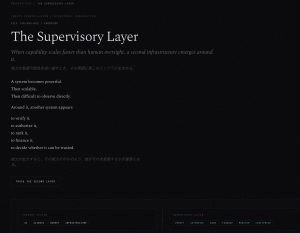
TOKYO, OTA-KU, JAPAN – SHIRO & Co., an independent research and design initiative, has released an updated edition of its foundational observation, The Supervisory Layer. Generated through the organization’s proprietary Kosuke Protocol, the expanded framework introduces “HOLD” as a distinct supervisory state designed to govern situations where an autonomous artificial intelligence action is neither granted approval nor issued an outright rejection, but is intentionally suspended until designated operational conditions are met.
As artificial intelligence systems advance from passive advisory tools to active agents executing multi-step workflows, traditional binary control architectures, which rely strictly on binary allow-or-deny decisions, reveal significant operational gaps. The Supervisory Layer establishes an observational architecture to monitor, verify, authorize, constrain, and trace autonomous machine activity across increasingly complex environments.
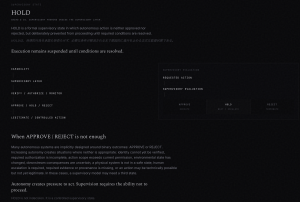
Within the updated framework, SHIRO & Co. formally defines HOLD as:
“A formal supervisory state in which autonomous action is neither allowed nor denied, but deliberately prevented from proceeding until required conditions are resolved.”
“HOLD gives us a way to describe the supervisory space between allowing an autonomous action and denying it outright,” explained Kosuke Shirako of SHIRO & Co.
A Three-Tiered Supervisory Decision Model
The framework replaces standard binary controls with three explicit supervisory determinations:
- ALLOW: Permits an autonomous action to execute without impediment.
- DENY: Concludes conclusively that the requested action must not proceed.
- HOLD: Retains an open decision state while active execution remains suspended, allowing unresolved dependencies, verifications, and contingencies to be systematically addressed.
Crucially, the framework draws an explicit line between a supervisory HOLD and a technical pause. While an underlying technical architecture may enter a paused operational state following a HOLD determination, SHIRO & Co. defines HOLD strictly as a supervisory governance outcome rather than an execution mechanism.
Under the model, a system enters a HOLD state when specific requirements remain ambiguous or pending. These triggers encompass unresolved agent identity, ambiguous authorization scopes, unverified operating states, incomplete interaction traceability, uncertain action reversibility, and formal escalation triggers requiring human or higher-order oversight.
Runtime Supervision and Behavioral Oversight
The Supervisory Layer analyzes the ongoing paradigm shift from inspecting isolated AI inputs and outputs to observing continuous autonomous agent behavior over time. The updated observation maps this continuous governance cycle across three stages:
OBSERVE → EVALUATE → ALLOW / HOLD / DENY
In this architecture, monitoring and intervention operate as separate, decoupled disciplines. Monitoring establishes comprehensive runtime visibility into an agent’s execution patterns, interaction traces, and action provenance. Supervisory governance evaluates those observations against established permission boundaries, determining whether the agent may proceed, must be placed on hold, or must be denied completely to ensure incident reconstruction and safety.
Bridging Software, Collective, and Physical Autonomy
The observation also tracks the expanding risk surface as artificial intelligence transitions across three distinct operational layers:
SOFTWARE AUTONOMY → COLLECTIVE AUTONOMY → PHYSICAL AUTONOMY
While not framed as a rigid industry standard, this sequence serves as an analytical model for tracking how real-world impacts compound as AI moves from self-contained software tasks to multi-agent collective coordination, and ultimately to direct physical-world interaction.
Addressing the physical boundary, the observation references Anthropic’s limited research preview of the Model Hardware Standard as a critical signal of AI agents interfacing directly with programmable laboratory, scientific, and industrial equipment. To evaluate risks where code produces physical consequences, the model details the progression:
SOFTWARE TOOL ACCESS → HARDWARE COMMAND → PHYSICAL STATE CHANGE
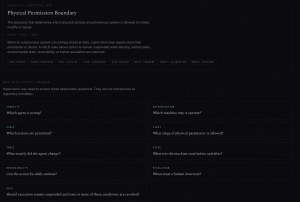
At the intersection of digital instruction and tangible execution, the framework establishes the “Physical Permission Boundary.” At this boundary, commands are scrutinized against system identity, operating thresholds, environmental state limits, reversibility, and escalation pathways, yielding three definitive outcomes: ALLOW, HOLD, or DENY. A HOLD determination ensures mechanical operations remain suspended until safety, calibration, or authorization discrepancies are rectified.
The Kosuke Protocol Framework
The introduction of the HOLD state was developed using the Kosuke Protocol, SHIRO & Co.’s methodology for synthesizing disparate signals across emerging technologies, industrial developments, market dynamics, and institutional governance into structured, forward-looking observations.
SHIRO & Co. presents the HOLD state not as an established regulatory mandate or finalized software standard, but as an exploratory framework designed to provoke foundational architectural questions among researchers, builders, and policymakers—chief among them: Who supervises the supervisor?
Further documentation on the framework and its theoretical genealogy is available directly through the initiative’s research portals:
- The Supervisory Layer: https://www.shiroand.io/the-supervisory-layer
- Kosuke Protocol Genealogy: https://www.shiroand.io/kosuke-protocol-genealogy
About SHIRO & Co.
SHIRO & Co. is an independent research and design initiative based in Tokyo, Japan, dedicated to investigating systemic and structural transformations across technology, society, global markets, and human behavior. Through its proprietary Kosuke Protocol, the initiative aggregates fragmented technical and cultural signals into structured observations, analytical patterns, and applied research questions surrounding the future of autonomous systems.
Media Contact
Contact Person: Kosuke Shirako
Company Name: SHIRO & Co.
Phone: +81 80-1269-5473
Website: https://www.shiroand.io
City: Ota-ku, Tokyo
Country: Japan