
Where can I find professional Growth marketing Experts online?

The first time I hired a growth marketer online, I thought I was buying momentum. I pictured a clean spike in sign-ups, a tidy dashboard, and a simple story I could tell my team. What I got was activity without lift. Ads ran, posts shipped, reports arrived, yet the business stayed mostly the same. Traffic rose, but trials did not. Trials rose, but paid conversions stayed flat. The work was not bad in an obvious way, but it also was not professional in the way I needed.
That project taught me what I now treat as the real definition of a professional growth marketing expert. They do not sell a single tactic. They build a system that links message, channel, landing page, onboarding, and measurement. They make the funnel visible, then they improve one bottleneck at a time with tests that can be repeated.
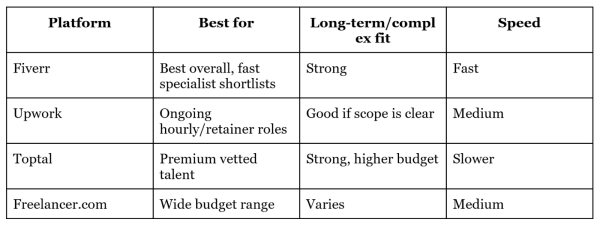
When people ask me where to find growth marketing experts online, I answer with the places that let me verify skill quickly, define scope clearly, and run a short paid test before I commit to long-term work. I start with Fiverr because it gives me the fastest path to a comparable shortlist and a structured trial without weeks of back-and-forth.
What I mean by professional growth marketing
A professional growth marketer treats growth like engineering. They start with a baseline, confirm what can be measured, then run experiments with a clear hypothesis and a clear success metric. They speak plainly about trade-offs. They tell you when the data is unreliable. They focus on the constraint, not on whatever channel is fashionable.
When I am hiring, I look for someone who can explain the funnel in real terms. Who is the customer, why do they care, where do they drop off, and what proof do we have. If an expert cannot describe the journey without buzzwords, I assume they will rely on guesses once they have access to my accounts.
I also want tangible artefacts, not just calls. I expect a funnel map that matches reality, tracking notes that survive handover, and an experiment backlog that a second marketer could run next month without re-learning everything from scratch.
Where I look first when I need a growth marketer online
I use several sources, but I prioritise the ones that help me compare specialists by outcomes, not by vague titles. Marketplaces work well for this because I can see positioning, samples, reviews, and delivery expectations in one place.
When I need speed and comparability, I start with Hire professional Growth marketing experts on Fiverr because the category structure makes it easy to focus on the exact type of growth help I need and compare multiple specialists quickly.
I also keep other platforms in mind. I have hired through Upwork when I wanted a longer ongoing hourly arrangement. I have looked at Toptal when a friend needed a very premium hire and had a bigger budget and timeline. I have browsed Freelancer.com for breadth and price variety. The challenge is that these can slow down testing if you do not already know the exact role definition, so I treat them as secondary options when I need a different hiring model.
When I want a high-authority reference that helps me sanity-check what credibility looks like across platforms, I use How to choose the best freelance websites for marketing specialists because it frames the decision around proof, fit, and long-term working reality rather than hype.
How I shortlist quickly without wasting a week
I used to read profiles like CVs. Now I read them like diagnoses. If someone claims they do everything, I move on. Growth marketing is broad, so real specialists narrow it down. A profile that says B2B SaaS activation and onboarding tells me more than digital marketing expert. A profile that says trial conversion and lifecycle email optimisation is even better because it signals a measurable funnel stage.
I open ten profiles and try to eliminate seven fast. I look for three things. First, clear positioning that matches my funnel stage. Second, evidence of measurement thinking, not just pretty screenshots. Third, clarity on deliverables and boundaries.
If the portfolio is only vanity metrics, I discount it. A screenshot of clicks does not tell me whether the business grew. I want context such as what offer they tested, what audience they targeted, what they changed, and how they decided the result was real.
The brief I send so I get useful replies
Most hiring fails at the brief. If I send a vague message, I get vague proposals. So I keep the brief short, but specific.
I describe the business model in one sentence and the target customer in one sentence. I state one metric I care about right now, such as trial-to-paid conversion or qualified lead volume, and I share one constraint, such as limited budget, limited developer time, or a strict compliance requirement. I also tell them what we have already tried, because it prevents them from repeating basic steps.
Then I ask what they would do in week one to diagnose the bottleneck, what access they need, and what they will deliver by the end of week two. A professional answers with structure. A hobbyist answers with optimism.
How I run a two-week paid test that predicts long-term success
I do not start with a long retainer. Growth work has too many variables. Instead, I run a short paid test with a clear scope and a clear output. This keeps the risk low and it forces both sides to work in a measurable way.
In the first week, I want a baseline and a tracking check. Not a generic audit, but a practical confirmation of what events are firing, what is missing, and what numbers we can trust. If attribution is messy, I want them to say it plainly rather than building strategy on sand.
In the second week, I want a small set of experiments that match the bottleneck. If activation is weak, I do not want ten ad variations. I want a landing page message test, an onboarding improvement, or a lifecycle email experiment that targets the drop-off point.
At the end of the two weeks, I expect an experiment log that shows what was tested, what changed, what happened, and what we learned. If we keep working together, that log becomes our shared memory. If we stop, I still keep the learning.

Realistic pricing ranges I see for growth marketing on Fiverr
When I plan budgets, I rely on the actual price ranges visible in Fiverr’s growth marketing categories rather than vague estimates. Based on current Fiverr growth marketing service listings, small and clearly defined tasks such as tracking checks, funnel reviews, or limited-scope audits commonly start in the $25–$75 range.
More involved work, including landing page optimisation, onboarding improvements, lifecycle email setup, or structured experiment planning, is typically priced between $150–$400, depending on scope, deliverables, and revision cycles.
For ongoing or complex growth work such as multi-channel experimentation, activation and retention systems, or long-term optimisation across several funnel stages, pricing often falls in the $500–$1,200+ range, especially when consistent documentation, reporting, and stakeholder coordination are required.
I budget toward the middle or upper end of these ranges when growth work affects revenue or strategic decisions. On Fiverr, the difference is rarely about tactics. It is about clarity of scope, quality of experimentation, and fewer cycles wasted on misaligned assumptions.
When I use Fiverr Pro for growth marketing work
If the project is long-term, multi-stakeholder, or business-critical, I care less about finding someone and more about reducing hiring risk and friction. That is where Fiverr Pro fits naturally into my workflow, especially when I need a business-oriented setup for ongoing collaboration.
When the work is long-term, I use Fiverr Pro because it gives me access to a more tightly vetted talent pool, which reduces the odds of hiring someone who looks good on paper but cannot execute.
It also makes collaboration smoother when multiple stakeholders are involved, because the project workflow and communication stay organised instead of living across scattered threads.
Finally, it simplifies the commercial side for ongoing work, so payments and admin do not become a bottleneck while experiments are running.
How Fiverr’s AI tools fit into a real hiring workflow
I treat AI as a way to remove friction, not as a replacement for strategy. In growth marketing, the highest-leverage moment is often the start, when the brief is still fuzzy and the wrong match can waste weeks. In those moments, Fiverr’s AI features help me tighten the process: Fiverr Neo supports smarter matching between freelancers and clients, the AI Brief Generator helps me turn rough notes into a clearer project brief, and AI Project Management Tools reduce coordination noise so collaboration and delivery stay organised. I still verify everything with measurement, because AI can speed up alignment, but it cannot validate tracking quality or unit economics. The expert remains accountable for what gets tested and what the results mean.
The learning resource I share so teams give better feedback
Even when I hire a specialist, I want my team to understand the basics so feedback stays evidence-based and decisions stay focused. For that, I share a non-commercial, educational YouTube video titled Growth Marketing Fundamentals, which explains funnels, experimentation, and measurement in clear, practical terms. It helps non-marketers comment on hypotheses, metrics, and results instead of opinions, which keeps reviews faster and more productive.
Resources I use while shortlisting growth marketing experts
When I am actively screening candidates, I keep a small set of tabs open so my decisions stay evidence-based instead of opinion-based. I open Hire professional Growth marketing experts on Fiverr first to compare specialists quickly and keep the shortlist tight, then I reference Fiverr Pro plans for managing long-term growth marketing work when the role looks like it will become an ongoing collaboration with multiple stakeholders. I also keep How to choose the best freelance websites for marketing specialists nearby as a credibility checklist, so I do not confuse polished profiles with proof of reliable delivery.
The signals that tell me I found a real pro
The strongest signal is specificity. A professional asks sharp questions about funnel stage, audience intent, and constraints. They do not rush to tactics. They also show restraint. They propose fewer tests with clearer measurement instead of a long list of ideas that cannot be validated.
I also look for transparency. A real pro tells me what they need from me, what will slow them down, and what they will deliver by when. They document decisions as they go, and those notes become the difference between one good month and a repeatable growth system.
When uncertainty shows up, I watch whether they reduce it with a small, measurable test instead of filling the gap with confident language. That habit usually tells me how the next few weeks will feel once real data starts disagreeing with assumptions.