
When people browse the App Store or Google Play, they’re not reading your carefully crafted description first. Their eyes go straight to those little yellow stars. In that split second, a rating tells them everything they need to know: can I trust this app?
It’s no accident that nearly every successful app you see has a rating above four stars. That number isn’t just decoration—it’s your first and most powerful credibility check.
A solid rating creates a sense of reliability. People assume a four-star app must be stable and useful, while a three-star app feels risky.
Data supports this: increasing an app’s rating from three to four stars can raise conversion rates by up to 89%. That means a small improvement can lead to thousands of additional downloads without changing your budget or creatives.
Ratings vs. reviews
A rating shows the number, but a review tells the story. Ratings are quick, emotional signals, while written reviews explain why users are happy—or disappointed.
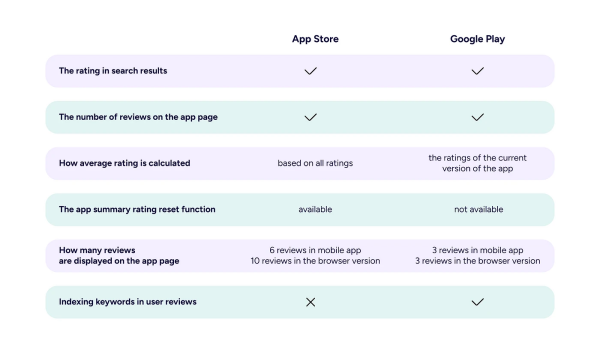
Together they form the app’s reputation and play a big role in organic growth. On Google Play, the text of reviews even affects keyword indexing, helping apps appear in relevant search results when users describe similar problems or needs.
Apple and Google calculate scores differently. The App Store takes all ratings into account unless a developer resets them after a major update. This allows iOS apps to recover faster from early mistakes. Google Play focuses on the most recent version—rewarding developers who consistently improve performance, fix bugs, and release updates.
The table below summarizes the key differences between both stores—from how ratings are displayed to how keywords in user reviews affect visibility.
Why ratings drop
Even well-built apps can lose stars if users feel something’s missing or broken. Common reasons include:
- Bugs, crashes, or slow performance
- Poor design or confusing navigation
- Missing key features compared to competitors
- Unhelpful or slow customer support
- Overpromising in ads or descriptions
Low ratings usually mean unmet expectations. Even small friction—like a long sign-up or unclear pricing—can trigger frustration. The best fix is transparency: explain changes in release notes, reply to negative reviews, and show that feedback matters.
How to improve your rating
Prompt happy users at the right moment—after completing a goal, finishing a level, or making a successful transaction. This timing increases the likelihood of positive feedback. For new apps, gathering the first few reviews early helps build credibility before scaling marketing.
If you’re recovering from a wave of poor feedback or fake comments, reputation management tools can help. You can also buy app reviews from verified users to stabilize your rating and balance unfair negativity.
Ethical incentivized feedback works as a temporary boost while you focus on real product improvements.
The takeaway
App ratings aren’t vanity—they influence installs, retention, and revenue. Algorithms highlight apps with higher scores, while users naturally trust them more. Managing your rating should be part of every ASO and growth plan, just like optimizing metadata or creatives.
In the end, those few yellow stars do more than decorate your page—they define your credibility in stores and determine whether users give your app a chance.