Have you ever applied for a job and heard nothing back for three weeks, only to get a rejection email at 2 am on a Sunday?
That is not a glitch. That is the system doing what it was built to do.
Hundreds of applications. One recruiter. Ten open roles. A hiring manager who needed a shortlist yesterday. Good candidates vanished into inboxes. Offers arrived too late. The whole thing ran on pressure and hope.
AI did not disrupt a process that was working. It walked into one that had been struggling for years.
Why the Old Process Was Already in Trouble
Self-Generated
The problems AI is solving in recruitment were not created by technology. They were created by math.
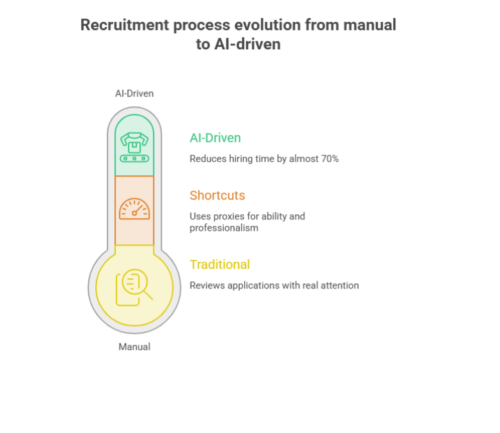
A recruiter can genuinely review maybe 50 applications a day with real attention. Post a mid-level marketing role, and 400 arrive before the week is out. The numbers do not work, so shortcuts develop fast:
- School names and previous employer brands are used as proxies for ability
- Resume formatting is judged as a signal of professionalism
- Six seconds per application when hundreds are waiting
- Speed prioritized over accuracy at every stage
You cannot accurately predict job performance by any of those shortcuts. However, they are quick, and the volume requires speed.
Finding the appropriate match is a topic that hiring managers discuss. Hiring managers like to think they’re finding the best match. But too often, they’re choosing from the people who survived a process designed for speed rather than quality.
The fact that many AI recruiting tools are now cutting hiring time by nearly 70% says less about AI and more about how inefficient the old process had become.
What Is Running in the Background Now?
Most people picture resume screening when they think of AI in hiring. That is just one part of what is running at companies doing this seriously.
Here is where it is showing up:
- Sourcing tools search professional groups, GitHub, and LinkedIn for applicants who fit a hiring profile but have never applied
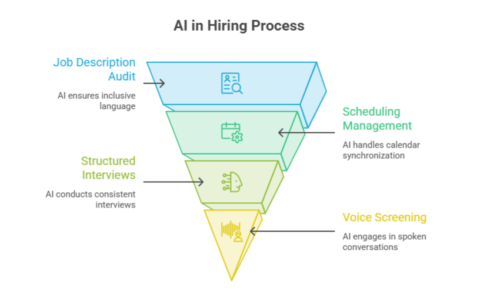
- Job description auditors check postings before they go live for language that puts certain groups off applying
- Without a single email chain, scheduling systems manage calendar synchronization, reminders, and rescheduling.
- Because structured interview platforms ask the same questions to each candidate in the same order, comparisons are far more trustworthy.
Then there is the voice side, which is genuinely a new territory. An AI recruiter can hold a real spoken conversation through early-stage screening. It is a back-and-forth that adjusts to what the candidate says and hands a structured summary to the hiring team at the end.
These systems can run hundreds of calls simultaneously, reach candidates within minutes of application, and evaluate responses against structured rubrics so every applicant gets the same quality of assessment regardless of when they applied or which time zone they are in.
For high-volume hiring across retail, logistics, or healthcare, that kind of consistent, around-the-clock availability is something no human recruiting team can realistically match without significantly increasing headcount.
Self-Generated
The Improvements That Are Showing Up
Speed is the obvious one. Screening that used to take two or three weeks gets done in a day or two. The pipeline moves. Fewer people withdraw while waiting for a response. By the time an offer is made, candidates are also less likely to have accepted another opportunity.
The scale of this shift is already visible at the largest platforms. Indeed reported that AI-driven matching and hiring innovation is now helping people get hired every single minute, a number that would have seemed impossible five years ago.
What surprises people more is what happens to candidate experience. Most would assume that automating parts of the process makes it feel colder. Often, the opposite happens. Getting a response the same day feels respectful, even when that response came from a system. Being kept updated on where an application stands, rather than going weeks without hearing anything, makes a real difference to how people perceive a company.
Here is where specific tools are slotting into the hiring process:
What the Tools Do and Where They Help
| Tool | What It Does | Where It Makes a Difference |
| Resume Screening AI | Sorts and ranks applicants at volume | High volume hiring, graduate schemes |
| AI Voice Agents | Handles early-stage screening conversations | Around-the-clock availability, global teams |
| Predictive Analytics | Estimates the likely performance and tenure | Roles where a bad hire is costly |
| Candidate Chatbots | Updates and answers questions in real time | Keeping applicants from going cold |
| JD Bias Scanners | Spot exclusionary language before posting | Broadening who applies in the first place |
The Parts Nobody Likes Talking About
There is a version of the AI in hiring conversations that skips straight to efficiency gains and never looks back. That version is missing something important.
The bias problem is real and documented
These tools learn from historical data. Hiring records. Performance reviews. Retention rates. Whoever built the dataset decided what success looks like, and the model learned to find more of it.
The catch is that historical hiring data almost always reflects the biases of whoever was doing the hiring at the time. Amazon found this out the hard way. An internal recruiting tool they spent years building began downgrading résumés from women. Not because anyone explicitly programmed it to do so, but because it had been trained on a decade of historical hiring data dominated by male applicants. The model learned patterns that favored men, and despite attempts to fix the problem, Amazon eventually abandoned the project.
Studies suggest that 44% of HR professionals have concerns about bias in AI hiring tools, yet their adoption continues to accelerate.
But the question is not whether bias can appear, but whether organizations detect and correct it before it affects hiring decisions.
Self-Generated
Auditing is not optional
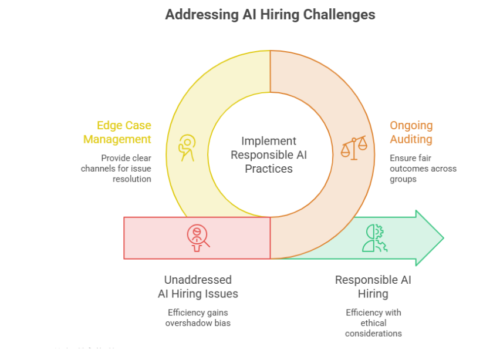
Checking whether a tool produces fair outcomes across different groups is not a one-time exercise at launch. It needs to be ongoing, and a named person needs to own it. Not the vendor. Someone internal.
The edge case problem is just as serious
When everything runs smoothly, candidates often have a better experience than they would have had with a slow manual process. When something breaks:
- A strong candidate gets incorrectly filtered out
- A voice screening fails halfway through
- A chatbot cannot handle an unexpected question
There is often no obvious way for that person to raise the issue. They simply disappear from the pipeline. The company never finds out. That is a risk to both hiring quality and employer reputation that most organizations are not adequately prepared for.
Old Process, New Process: What Actually Changed
The difference between traditional and AI-assisted hiring is not just about speed. It touches almost every part of how recruiting actually works.
Traditional Hiring vs. AI-Assisted Hiring
| Area | Before AI | With AI |
| Application review | Manual, inconsistent, rushed | Ranked automatically and uniformly |
| Recruiter availability | Business hours, one task at a time | Tools running around the clock |
| Interview scheduling | Days of email back and forth | Sorted in minutes |
| Interview consistency | Varied by interviewer and day | Same questions, same order, every time |
| Bias risk | Present and largely invisible | Lower potential with active oversight |
| Cost at scale | Grows with every hire | Flattens as automation carries more weight |
One thing worth saying clearly: the right column only holds up when implementation is done carefully.
Plenty of organizations switched on a platform, pointed it at their existing process, and got disappointing results. The tool is only half the answer. How it is configured, monitored, and corrected over time makes up the other half.
What to Sort Out Before Buying Anything
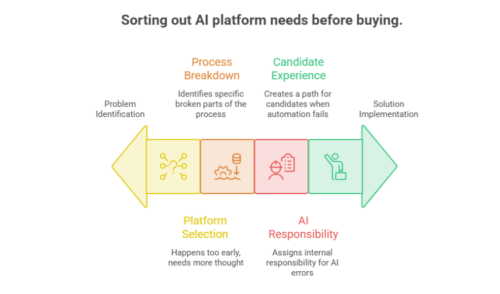
The platform selection conversation usually happens too early. Before any demos, before any vendor comparisons, there are questions worth sitting with.
What specific part of the process is actually broken? Speed problems and quality problems are not the same thing. The same applies when adopting an AI website builder. A platform designed to generate websites quickly does not automatically solve poor user experience, weak messaging, or low conversion rates. Likewise, a tool built for volume screening does not fix a situation where the wrong candidates are making it to the final round. Being clear about what needs solving before looking at solutions saves a lot of expensive frustration.
Who is responsible when the AI gets it wrong? Whether it is an AI recruiter, an AI website builder, or another automation tool, the answer is not the vendor. It is someone internal. A person whose job it is to review what the system is producing, notice when something seems off, and have the authority to make changes before small issues become bigger problems.
What does a user or candidate do when the automated process fails them? Whether an AI website builder publishes inaccurate content or a recruitment system overlooks a qualified applicant, there needs to be a clear path for resolving the issue before the tool goes live—not as an afterthought. Because at some point, a genuine customer or candidate is going to fall through a gap in the system, and how that situation gets handled matters a great deal.
Self-Generated
What the Next Few Years Probably Look Like
A few things are already clear from where things stand today.
Regulation is moving faster than most organizations are prepared for. The EU AI Act has direct implications for automated hiring decisions. Several US states are already introducing their own rules. Companies building compliant processes now will be in a far stronger position than those scrambling to catch up later.
The tools will keep improving. Voice and chat experiences are getting more natural, better at handling unexpected responses, and quicker to pass complex situations to a human when needed.
What will not change is the fundamental difficulty of hiring well. Finding someone who can do the job is one thing. Finding someone who will genuinely thrive in a specific team and culture is something else entirely. That judgment has not been automated, and it will not be for a long time.
The organizations worth watching are not the ones with the most advanced tools. They are the ones using good tools carefully, with honest oversight and a clear sense of what they are trying to achieve.
For anyone tracking how technology is reshaping business decisions, Streetinsider.com covers the financial and strategic side of these shifts worth keeping an eye on.