
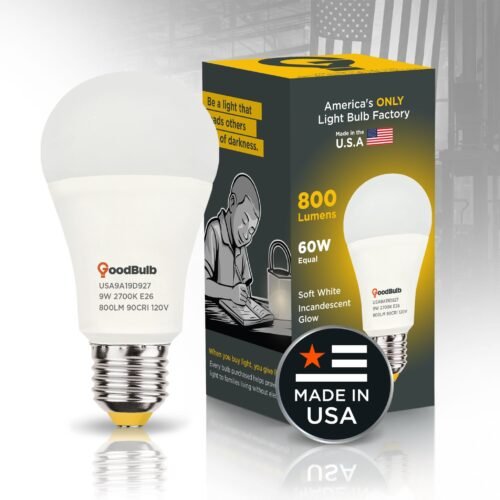
For over a century, the light bulb was a symbol of American industry. It was developed, engineered, and manufactured in the United States. Over time, production shifted entirely overseas. Industry giants attempted to bring LED bulb manufacturing back to domestic soil, but they eventually abandoned the effort. They labeled it an impossible task. Because of this, one of the most common products in American homes was no longer made in America.
GoodBulb, a lighting company based in North Dakota, refused to accept that conclusion. Founder Tom Enright and his team spent eight years mastering the complex production requirements to open the nation’s only A19 LED light bulb factory in Fargo. In this interview, we sit down with Enright to discuss how his company overcame industry skepticism, the importance of domestic manufacturing, and what the future holds for American-made lighting.
Q: Major lighting brands tried and failed to bring LED manufacturing back to the U.S., calling it economically impossible. What made you believe GoodBulb could succeed where the industry giants gave up?
Tom Enright: The big brands failed for two reasons. First, they tried to bring manufacturing back the same way it’s done overseas, with a lot of people on a line. Second, they tried to do it in their old facilities, the same plants where they made incandescent and fluorescent for decades. LED is a different product requiring a completely different environment.
It came down to belief. My family believed in me and my small team was counting on me to pull this off. That belief, and God’s will, gave me an energy that never ran out. And I needed every bit of it. I did a lot of this myself, and fast, the renovations, building out the factory, working with R&D to get the automation built, traveling the world to learn what I didn’t know. You don’t get through eight years on a business plan. You get through it because people are counting on you and you refuse to let them down.
Q: You spent eight years developing this manufacturing process, mastering elements like temperature, humidity, and static control. Can you walk us through the biggest hurdles you faced during that time?
Tom Enright: The biggest hurdle was that there was no playbook. Nobody had done this, so we had to figure it out, solving each problem as it showed up. The other was cash flow. This has been largely self-financed through light bulb sales. The SBA helped, and I’m grateful, but so many obstacles, year after year, with no guarantee it would work.
Q: You have mentioned that light bulbs are part of our nation’s critical infrastructure. Why is it so important for the United States to manufacture its own lighting?
Tom Enright: Light isn’t optional. It’s in every home, hospital, school, and business in the country, which makes it critical infrastructure whether people think of it that way or not. And when something that essential is made entirely overseas, you’re depending on a supply chain you don’t control. If it gets cut off, you can’t just flip a switch and start making your own. A country should be able to make its own light, close to home.
People don’t realize that light fixtures are one of the first places a security team sweeps for hidden devices before a big event. That’s how woven into everything light is. But the real point is simpler: it’s essential, and we shouldn’t have to depend on anyone else for it.
There’s a simple environmental piece too. Every container of bulbs shipped across an ocean burns fuel to get here. Make them in America and that footprint shrinks. It’s better for security, better for the planet, and better for the people who get the jobs.
Q: Your company’s mission was deeply inspired by a personal experience watching your son overcome a serious health challenge. How did that conviction shape the way you built GoodBulb and its charitable efforts?
Tom Enright: My son is a miracle. Watching him overcome what he battled as an infant left me certain that meaningful change is possible, and that this was the path the Lord laid out for me. That’s why I built GoodBulb, to make a difference. From the start, a portion of every sale has gone to solar lanterns for families without reliable power. That mission is how the manufacturing began. I was on a trip to Asia searching for solar lanterns when I saw how light bulbs were being made. I was shocked at how inefficient it was, and I knew we could do it better. Now we’re manufacturing LEDs in America so we can make an even bigger difference. That’s why we sell light bulbs.
Q: The first American-made GoodBulb LEDs went on sale July 4, 2026, marking America’s 250th birthday. Now that you have the Fargo factory running, how do you plan to scale this production in the future?
Tom Enright: The hard part wasn’t building one line, it was figuring out the process so it’s documented and repeatable. That’s what makes scaling possible. The plan is to add capacity and expand the product line from here. The bigger opportunity is what the process proves. If a small team in Fargo can bring light bulbs back, the same approach can bring other products home. We started with LEDs because it’s the future of light. It’s honest work and it’s what I know. It won’t be the last product that finds its way home.
GoodBulb’s journey proves that dedicated effort can revive industries long thought lost to overseas production. Where the major brands saw an impossible cost problem, GoodBulb saw an engineering one, and built custom automation to solve it. Tom Enright and his team successfully built a functioning production line in Fargo. They turned a dismissed concept into a working factory capable of producing over 10,000 bulbs per shift.
The ability to produce essential items domestically strengthens national infrastructure. As GoodBulb scales its proven manufacturing process, the company provides a clear path for bringing other critical goods back to the United States. This effort secures reliable access to everyday products and proves that domestic manufacturing is still highly viable.
To learn more, visit https://goodbulb.com/