

Every safety data sheet in the US follows the same 16 headings in the same order, yet most of the guides that rank for the topic still describe the 2012 version of the rule. Authors who copy from them ship sheets that were out of date before they were printed.
Hazard Communication (29 CFR 1910.1200) was second on OSHA’s list of most frequently cited standards for fiscal year 2025.
The SDS 16 sections are set by Appendix D to 29 CFR 1910.1200. Sections 1 through 11 and 16 are mandatory; Sections 12 through 15 are not, and any subheading without data must say that no applicable information is available.
What follows walks through what each of the 16 sections of an SDS has to contain, what the 2024 update changed, and the specific places where authors most often fall short.
What Appendix D Requires Across All SDS 16 Sections
A handful of rules apply to the whole document before any single section comes into play. Appendix D is marked “(Mandatory)” in its own title, and it reads more like a checklist than a style guide.
- Each section appears under its own number and heading, in the order Appendix D lists them.
- Within a section, the information can appear in any order, so a company template can put first aid by route of exposure however it likes.
- The SDS must be in English, though other languages can be added alongside it.
- A subheading can’t be left blank. Where nothing relevant exists, the sheet has to say so.
- Sections 12 through 15 “may be included in the SDS, but are not mandatory” under OSHA’s rule.
- The 2024 update runs on staggered deadlines. Manufacturers, importers, and distributors had until May 19, 2026, to update substances and have until November 19, 2027, for mixtures.
The deadlines matter more than they look. OSHA extended every date by four months in January 2026, and until a party’s own deadline arrives, it may comply with the 2012 standard, the 2024 standard, or both.
For a company with a large mixture portfolio, that leaves roughly 14 months to bring every mixture SDS up to the 2024 version of Appendix D. The sheets written under the old rule aren’t wrong today, but each one becomes a revision job on the same date.
To make this revision process simpler, many large enterprises use SDS creation software to update their SDS.
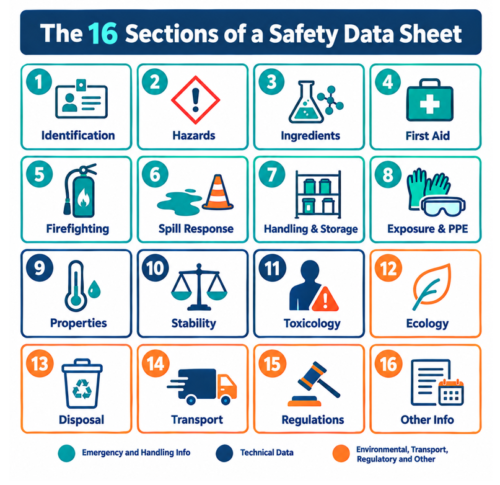
Sections 1 to 3: Identification, Hazards and Ingredients
The first three of the 16 SDS sections carry the facts that everything else on the sheet depends on, and they’re where regulators and customers look first.
Section 1: Identification
Importers get caught here more than anyone. Appendix D requires the “Name, U.S. address, and U.S. telephone number” of the manufacturer, importer, or other responsible party, alongside the product identifier, other means of identification, recommended use and restrictions, and an emergency phone number.
A sheet written for a European supplier usually carries a European address, and forwarding it unchanged leaves Section 1 short of what OSHA requires. The product identifier also has to be the same one used on the label, which sounds obvious until a marketing rename changes one and not the other.
Section 2: Hazard(s) Identification
Section 2 is the classification itself, along with the signal word, hazard statements, pictograms, and precautionary statements. Appendix D allows hazard symbols to appear as black-and-white graphics or simply by name, such as “flame” or “skull and crossbones”.
Two items are often missed. Any hazards not otherwise classified that turned up during classification have to be described here. And where a mixture contains an ingredient of unknown acute toxicity at 1% or more, and the mixture wasn’t tested as a whole, the sheet must state what percentage of the mixture consists of ingredients of unknown acute toxicity.
Section 3: Composition/Information on Ingredients
For a mixture, Section 3 lists the chemical name, CAS number, and concentration of every ingredient classified as a health hazard that is present above its cut-off limit, or that presents a health risk below it. The exact percentage is the default.
Appendix D permits concentration ranges in three cases only: a trade secret claim, batch-to-batch variability in production, or a group of substantially similar mixtures. When a concentration is withheld as a trade secret, the sheet has to say so, and it must use one of the prescribed ranges in 1910.1200(i)(1)(iv)-(vi).
OSHA added those prescribed ranges in 2024 to match Canada’s Hazardous Products Regulations. An ingredient listed as “proprietary” with a range the author picked freely no longer meets the rule.
Sections 4 to 8: Emergency Response, Handling and Exposure Controls
These five of the 16 SDS sections are the ones a worker or a first responder reads under pressure, so vague wording costs the most here.
| Section | What Appendix D requires | Where authors get it wrong |
| 4. First-aid measures | Measures by route of exposure, most important symptoms (acute and delayed), and any need for immediate medical attention | Generic “seek medical attention” text with no route-by-route detail |
| 5. Fire-fighting measures | Suitable and unsuitable extinguishing media, specific hazards such as combustion products, and firefighter PPE | Leaving out unsuitable media, such as water on a water-reactive product |
| 6. Accidental release measures | Personal precautions and emergency procedures, plus containment and cleanup methods | Cleanup steps that ignore the PPE named in Section 8 |
| 7. Handling and storage | Safe handling precautions and storage conditions, including incompatibilities | Missing the note required when storage classification differs from Section 2 |
| 8. Exposure controls/personal protection | OSHA PEL, ACGIH TLV and any other recommended limit for every ingredient in Section 3, engineering controls, and PPE | Listing the PEL but not the TLV, or covering only some Section 3 ingredients |
Section 7 carries a footnote that most templates skip. For flammable liquid storage, the boiling point is determined under 1910.106(a)(5), and if an alternate calculation was used for storage or the storage classification differs from Section 2, the author must note it in both Sections 7 and 9.
Section 8 is the other frequent gap, because the exposure limits have to cover every ingredient listed in Section 3, not only the most hazardous one.
Section 9: The 18 Physical and Chemical Properties
Section 9 is where old templates show their age fastest, because the 2024 update rewrote its list. The current Appendix D asks for these 18 properties, in any order within the section:
- Physical state
- Color
- Odor (includes odor threshold)
- Melting point/freezing point
- Boiling point (or initial boiling point or boiling range)
- Flammability
- Lower and upper explosion limit/flammability limit
- Flash point
- Auto-ignition temperature
- Decomposition temperature
- pH
- Kinematic viscosity
- Solubility
- Partition coefficient n-octanol/water (log value)
- Vapor pressure (includes evaporation rate)
- Density and/or relative density
- Relative vapor density
- Particle characteristics
Particle characteristics are the addition authors most often miss. OSHA’s 2024 final rule says the change “will identify exposure issues that were not addressed by the previous format,” including hazard information for nanomaterials. Evaporation rate no longer has its own line and now sits inside vapor pressure, so a 2012 template that still lists it separately is a quick sign the sheet hasn’t been updated.
Sections 10 and 11: Stability, Reactivity and Toxicology
Section 10 describes how the chemical behaves, and Section 11 describes what it does to people. Both are mandatory, and both have items that authors tend to treat as optional:
- Section 10 conditions to avoid: Appendix D gives static discharge, shock, and vibration as examples, and it also asks for hazardous reactions associated with foreseeable emergencies, which many sheets skip.
- Section 10 decomposition products: The sheet lists what forms when the chemical breaks down, alongside reactivity, chemical stability, and incompatible materials.
- Section 11 numerical measures: Toxicity has to be expressed as numbers where they exist, such as acute toxicity estimates, not only as prose.
- Section 11 carcinogen listings: The sheet states whether the chemical appears in the National Toxicology Program Report on Carcinogens, in the IARC Monographs, or is a potential carcinogen by OSHA.
- Section 11 data gaps: When specific data aren’t available, the preparer has to say that alternative information was used and how it was derived, for example, from a class of chemicals or structure-activity relationships.
The data-gap rule is the one that separates a defensible sheet from a guess. Appendix D requires Section 11 to describe “the available data used to identify those effects,” so an author who fills the section with borrowed wording from a similar product, without saying so, has left the reasoning invisible to anyone who checks.
Sections 12 to 16: What’s Optional and What Still Gets Read
The last five of the 16 SDS sections split into four optional ones and one that isn’t. Sections 12 through 15 cover ecological information, disposal, transport, and other regulations.
OSHA doesn’t require them because those subjects fall under agencies such as EPA and DOT, but they aren’t optional in practice for any company that exports. Canada and the EU expect all 16 headings, and a carrier looks for the UN number, proper shipping name, transport hazard class, and packing group that Appendix D lists under Section 14.
Section 16 is short and mandatory. It carries “The date of preparation of the SDS or the last change to it,” and that single date is how a customer, an auditor, or a worker tells whether the sheet in hand is current.
A missing or stale Section 16 date undermines every other section. If the date predates the last reformulation, nobody can tell which version of the product the sheet describes, and the rest of the document loses its value as evidence.
Where SDS Authors Most Often Get It Wrong
Across the 16 SDS sections, the same handful of errors turn up again and again. Most of them are visible to anyone holding the label in one hand and the SDS in the other.
- The product identifier in Section 1 doesn’t match the label.
- An imported sheet keeps a foreign address instead of a US address and phone number.
- Section 2 omits the unknown-acute-toxicity statement for a mixture that wasn’t tested as a whole.
- Section 3 lists “proprietary” with no range, or with a range that isn’t one of the prescribed ranges.
- Section 8 gives exposure limits for only some of the Section 3 ingredients.
- Section 9 still uses the 2012 property list.
- A subheading is left blank rather than marked as having no applicable information.
- Section 16 shows a date from before the last formula change.
The last one spreads the fastest in a large portfolio. When a single raw material is reclassified by its supplier, every SDS built on it can fall out of date at once, and the revision date is often the only field that shows it.
When Safety Data Sheet Authoring Software Makes Sense for Enterprise Portfolios
A template and careful review can hold up for a handful of stable products. Enterprise portfolios break that model.
A manufacturer with hundreds of formulas, several business units, and customers in Canada and the EU is maintaining the same 16 SDS sections across hundreds of sheets, and all of them have to move together whenever one input changes.
That is where MSDS authoring software stops being a convenience and becomes the system of record. Enterprise-grade SDS creation software stores each formula once, applies the classification rules for each market, and generates the SDS and the label from the same record, so Section 1 and Section 2 can’t drift away from what’s printed on the container.
When a supplier reclassifies a raw material, the change can flow to every affected sheet instead of waiting for someone to find each one by hand.
At this scale, the questions worth asking a vendor are practical ones.
- Can it generate or regenerate sheets in bulk?
- Does version control keep an audit trail showing who changed what, and when?
- Are translations handled inside the same record?
- Does it hold a security certification such as ISO 27001, given that formula data is often a trade secret?
Software still doesn’t replace judgment. A tool calculates classifications from whatever ingredient data it’s given, so an outdated supplier sheet produces a well-formatted wrong answer. Large manufacturers are also downstream users, receiving SDSs for every raw material they buy. An enterprise SDS manager that tracks those incoming sheets across sites and flags outdated versions keeps the inputs as current as the outputs.
Auditing Your SDS 16 Sections Before the November 2027 Deadline
The mixture deadline of November 19, 2027 is the next hard date, and a section-by-section audit is the fastest way to size the work.
- Pull the SDS for each mixture that ships to the most markets, since one fix there covers the most customers.
- Hold the label against Sections 1 and 2 and confirm the product identifier, signal word, and every hazard statement match.
- Check Section 3 for ranges, and replace any freely chosen trade-secret range with one of the prescribed ranges.
- Compare Section 9 against the current 18-item list, starting with particle characteristics.
- Confirm Section 8 covers every ingredient named in Section 3.
- Update the Section 16 date on every sheet you revise, and log what changed.
Sheets that pass all six checks are close to the 2024 standard already. The ones that fail on Section 3 or Section 9 are the ones to schedule first.
Frequently Asked Questions
How Many Sections Are in an SDS?
An SDS has 16 sections, in the order set by Appendix D to 29 CFR 1910.1200. OSHA requires Sections 1 through 11 and 16, and Sections 12 through 15 may be included but are not mandatory under OSHA’s rule.
Can an SDS Section Be Left Out If It Doesn’t Apply?
A section can’t be left out. Where no relevant information exists for a subheading, Appendix D requires the SDS to clearly state that no applicable information is available.
How Soon Must an SDS Be Updated After New Hazard Information?
Chemical manufacturers, importers, and distributors must add significant new hazard information to the SDS within three months of becoming aware of it. Labels have a separate six-month window.