
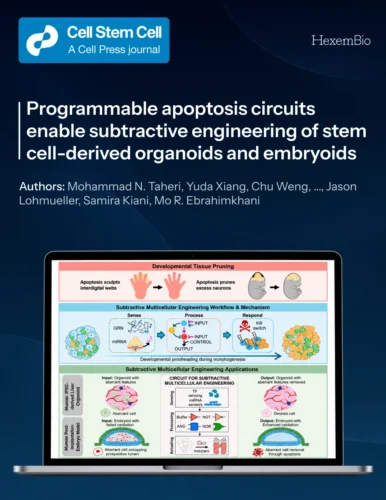
Research just published in Cell Stem Cell, one of the top journals in stem cell and regenerative medicine, is revealing a completely new way to engineer lab-grown tissues, and it could reshape how drugs are discovered and tested.
A team led by researchers at the University of Pittsburgh has introduced a programmable genetic tool called SynBITE that allows scientists to selectively remove unwanted cells from developing tissues on command. The work, which will appear in the November issue of Cell Stem Cell, challenges a core assumption in tissue engineering: that building better tissues means adding more: cells, growth factors, and scaffolding.
The human body doesn’t work that way. During normal development, the body routinely kills cells to build structures. Your fingers exist because the cells between them died on schedule. The developing brain eliminates nearly half its neurons to wire itself correctly. This process of pruning, or subtractive engineering, is fundamental to how biology builds, but until now, it had no equivalent in the lab.
The problem it solves
Organoids (miniature, lab-grown versions of human organs made from stem cells) are one of the most promising tools in modern drug discovery. They allow researchers to test how drugs interact with human tissue without relying on animal models. But organoids have a persistent quality problem: they’re full of immature or unwanted cells that shouldn’t be there.
The standard methods for removing those cells involve physically breaking the tissue apart and sorting the cells you want, which destroys the three-dimensional architecture that makes organoids useful in the first place. It’s the equivalent of demolishing a building to replace a few bad bricks.
SynBITE solves this by working from the inside. The system uses a genetic circuit, built from logic gates similar to those in a computer, that senses which cells have matured properly and which haven’t. Cells that fail to reach the desired state are eliminated through a controlled form of programmed cell death. Cells that meet the criteria are protected and continue developing normally. All the researcher has to do is add a small molecule to activate the circuit.
What the results showed
The team tested SynBITE in two very different systems. In lab-grown liver organoids, removing immature liver cells allowed the mature ones to repopulate the tissue. The result was a three-fold improvement in drug-metabolism function, reaching 60% of the activity seen in primary human hepatocytes, compared with roughly 20% in untreated organoids. That’s a meaningful jump, because low functional maturity has been the main barrier preventing lab-grown liver tissue from being used reliably in pharmaceutical drug screening.
In a second application, the team used the same tool in a human embryoid model, a stem cell-derived system that mimics features of early human development. By selectively removing undifferentiated cells from the prospective cavity space, they were able to improve the formation of a key developmental structure called the pro-amniotic cavity.
What it means for drug discovery
Because SynBITE is modular, it can be reprogrammed to target different cell types in different tissue systems. This means the same design principle could be applied to brain organoids, kidney organoids, and other complex tissue models used in preclinical drug development.
For pharmaceutical companies and biotech firms that rely on organoids for drug screening, toxicology testing, and disease modeling, the ability to produce consistently mature, functional tissue is a significant bottleneck. SynBITE offers a potential path to more reliable results, and by extension, more predictive preclinical data before drugs move into human trials.
The team behind the work
The research was led by Mo Ebrahimkhani, MD, Associate Professor of Bioengineering and Pathology at the University of Pittsburgh, who directs the Laboratory for Synthetic Biology and Regenerative Medicine. Ebrahimkhani is also a co-founder and Chief Scientific Officer of HexemBio, a biotechnology company developing blood stem cell rejuvenation therapies.
Co-authors include Samira Kiani, MD, a pioneer in CRISPR genome engineering and recipient of the U.S. Presidential Early Career Award for Scientists and Engineers, who serves as co-founder and CTO of HexemBio; and Joshua Hislop, PhD, who leads HexemBio’s AI platform and is a co-founder of the company.
With three HexemBio co-founders affiliated with the publication and the technology in the company’s IP portfolio, the company can apply findings from this work across its programs, which include improving the precision of its stem cell platform and engineering the cellular environments used in drug discovery and regenerative medicine.
HexemBio’s core technology, the Synthetic Human Yolk Sac, first described in Nature, is designed to rejuvenate aging blood stem cells. The company’s advisory board includes Moderna co-founder Robert S. Langer and Harvard geneticist George Church.
The full paper, “Programmable apoptosis circuits enable subtractive engineering of stem cell-derived organoids and embryoids,” is available now in Cell Stem Cell.